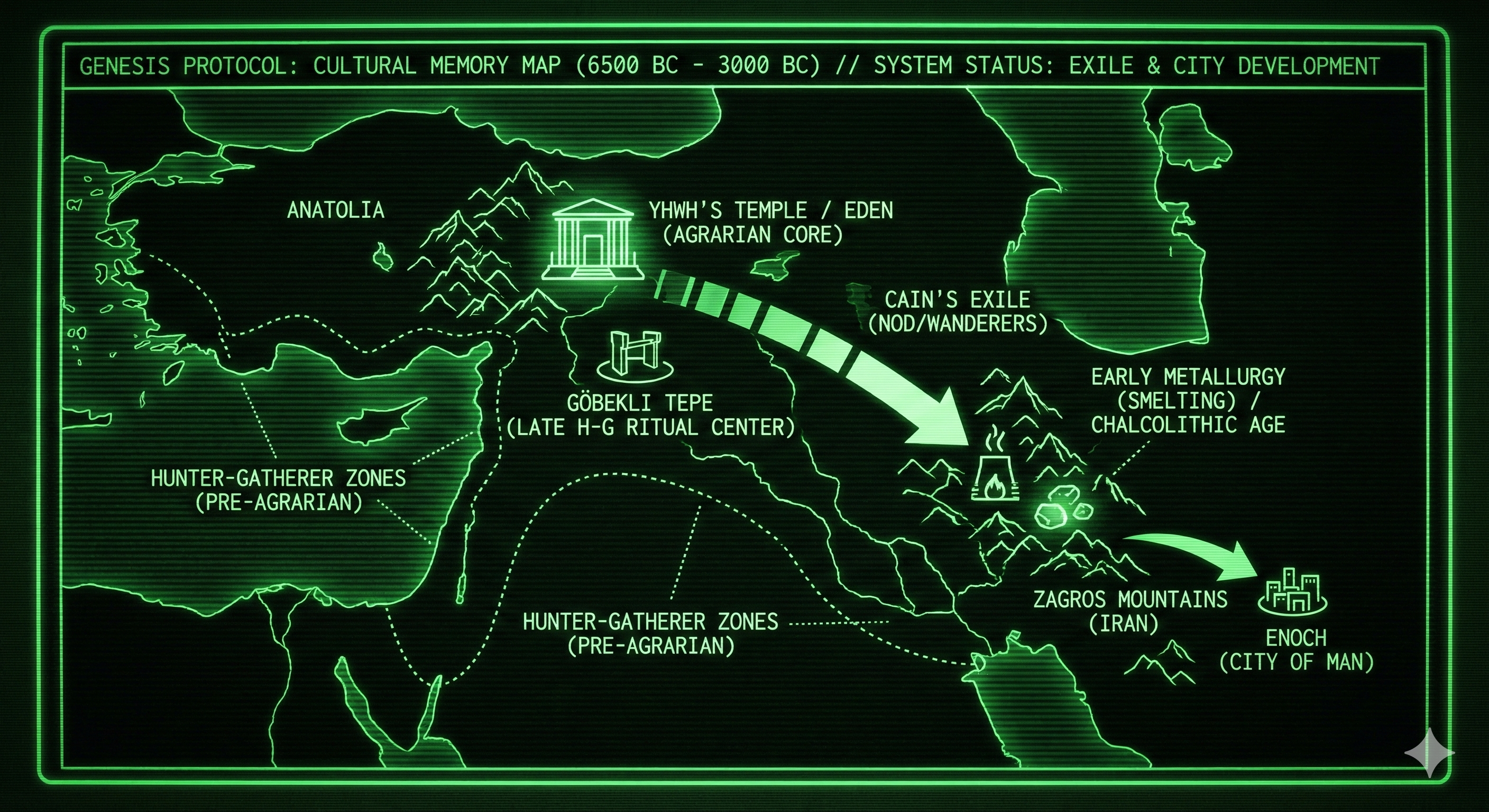
Genesis Protocol
The Neolithic Intersection & The Violence Ceiling
Adam and Eve function as the first Priests—humans endowed with the specific Image of God and placed in Sacred Space (Eden) to "work and keep" it. Anthropologically, this mirrors the shift from the Hunter-Gatherer existence to the Agrarian Revolution.
However, the text implies that outside the garden, the "Old World" continued to exist—bands of nomadic humans living by the spear and the gather. This "Wild" world is the backdrop for the first great tragedy of human civilization.
When Cain killed Abel, he introduced Fratricide (murder of kin) into the human code. As punishment, he was exiled East, toward the rising sun and the dark mountains. He was terrified of the "Wild Men" of Nod.
Cain settled in the "Land of Nod" (literally "Wandering"). Geographically, "East of Eden" pushes toward the Zagros Mountains (modern Iran), a critical location because it is the geological cradle of metallurgy. Cain had two advantages over the wild populations of the East: the Mark of God (supernatural protection) and Agrarian Technology (farming).
The Göbekli Tepe Hypothesis: An Evolutionary Upper Limit
In this context, sites like Göbekli Tepe (dating to approx 9500 BC) serve as a profound archaeological data point. These sites represent the absolute zenith of Hunter-Gatherer culture—massive stone temples built by people who had not yet mastered farming or pottery. They prove that the spiritual impulse predated the technological one.
However, Göbekli Tepe was eventually buried—intentionally. This suggests a civilization hitting a hard ceiling. The Hunter-Gatherer world had an Evolutionary Upper Limit. Without the mechanisms of Violence Mitigation—such as the Wergild (Law) or the future teachings of Jesus (Grace)—there is no stability.
A society ruled by the Blood Feud cannot scale. It cannot possess "nice things" because it cannot sustain the peace required to create them. It cannot pursue God's attributes because it is consumed by the defense of its own ego and territory. The "Wild" world hit this ceiling and collapsed. Cain’s innovation was not to fix the violence, but to industrialize it.
// SECTOR 02The City of Man: Breaking the Ceiling via Domination
It is a profound narrative irony: the line of Cain—exiled from God’s presence—becomes the line of cultural brilliance. They build the "City of Man" to make life bearable in a cursed world.
If we view Cain's line not as a nuclear family but as a Dynasty of Technologists, they represent the shift to the Chalcolithic (Copper-Stone) Age. They broke the "Hunter-Gatherer Ceiling" not by seeking God, but by mastering the earth and subjugating their neighbors through superior economics and weaponry.
| Innovator | Invention | Cultural Implication |
|---|---|---|
| JABAL | Livestock & Tents | The Mastery of Economics. Represents the accumulation of wealth. In a feud culture, wealth buys influence and insulates one from consequences. |
| JUBAL | Lyre & Pipe | The Mastery of Arts. Represents leisure. Music may have been used to glorify human power—turning Lamech’s boast of murder into a cultural anthem. |
| TUBAL-CAIN | Bronze & Iron | The Mastery of Warfare. While "instruments" can mean tools, in the hands of Lamech, they inevitably become weapons. |
Why did the "ungodly" line invent all these things? They were trying to overcome the Curse through human effort.
God said: "You will have sorrow." -> Jubal said: "I will soothe it with music."
God said: "You are vulnerable." -> Tubal-cain said: "I will forge iron to protect us."
The Mechanics of Vengeance
The technological prowess of Cain's line inevitably led to the mechanization of violence. This culminates in Lamech, the first poet and the first polygamist.
Lamech usurps the divine protection God gave Cain ("sevenfold vengeance") and twists it into a human threat. He claims a right to "seventy-sevenfold" vengeance. This is the logic of Zero Tolerance: in a blood feud culture, you do not seek justice (equality); you seek intimidation (dominance).
The tragedy of Lamech is the total absence of Violence Mitigation. In a healthy society, law (Wergild) steps in to say, "The penalty for a wound is a fine, not death." In the Kingdom of God, Jesus steps in to say, "Forgive seventy-seven times."
Lamech rejects both. He chooses the path of the Totalitarian. He uses the iron forged by his son Tubal-cain to ensure that no one dares to strike him. This is "Peace through Terror," and it is the only kind of peace the City of Man can manufacture.
// SECTOR 04The Sethite Option
While Lamech’s city was echoing with the clang of iron and the boast of murder, a quiet counter-culture was forming in the line of Seth. Seth names his son Enosh, which in Hebrew means "mortal," "frail," or "incurably weak."
| The Way of Lamech (Cain) | The Way of Enosh (Seth) |
|---|---|
| Boasting: "I have killed a man." | Confessing: "We are Enosh (weak/mortal)." |
| Solution: Technological superiority (Iron). | Solution: Divine Intervention (Prayer). |
| Goal: Make a name for themselves. | Goal: Proclaim the name of the Lord. |
"At that time people began to call upon the name of the Lord" (Gen 4:26).
This was a tactical decision. The Sethites realized they could not out-fight Tubal-cain's iron. They admitted their frailty. They engaged in the only act that could supersede the blood feud: Appeal to Heaven. They weaponized prayer instead of metal. Genesis 5 acts as a tolling bell to remind us that even the technologically advanced Cainites could not outrun death.
The Flood as Sabbath & The Hard Reset
The genealogy ends with another Lamech—not the murderer, but a weary man seeking hope. He names his son Noah (Noach), meaning "Rest." He prophesies that Noah will bring relief from the "painful toil."
The Flood acts as the final "Violence Mitigation" strategy of God. Because the culture of Cain had consumed the world, and because the hunter-gatherer limit had been shattered by iron and cruelty rather than grace, the only option left was a Hard Reset.
However, the tragedy of the narrative is immediate. Upon exiting the Ark, the "New Adam" (Noah) plants a vineyard, gets drunk, and falls naked in his tent. His son Ham commits a shameful act, leading to a new curse.
This proved the final, devastating thesis of the Genesis Protocol: While the Flood could wash the earth, it could not wash the human heart. The problem of sin survived the boat ride. The Violence Ceiling would have to be broken again—not by iron, and not by water, but eventually, by the Blood of a new covenant.
// SYSTEM CONNECTIONS




[ X.COM PROFILE ]