// SYSTEM DIRECTORY: MODULE ACCESS
> I. The Divine Council Framework
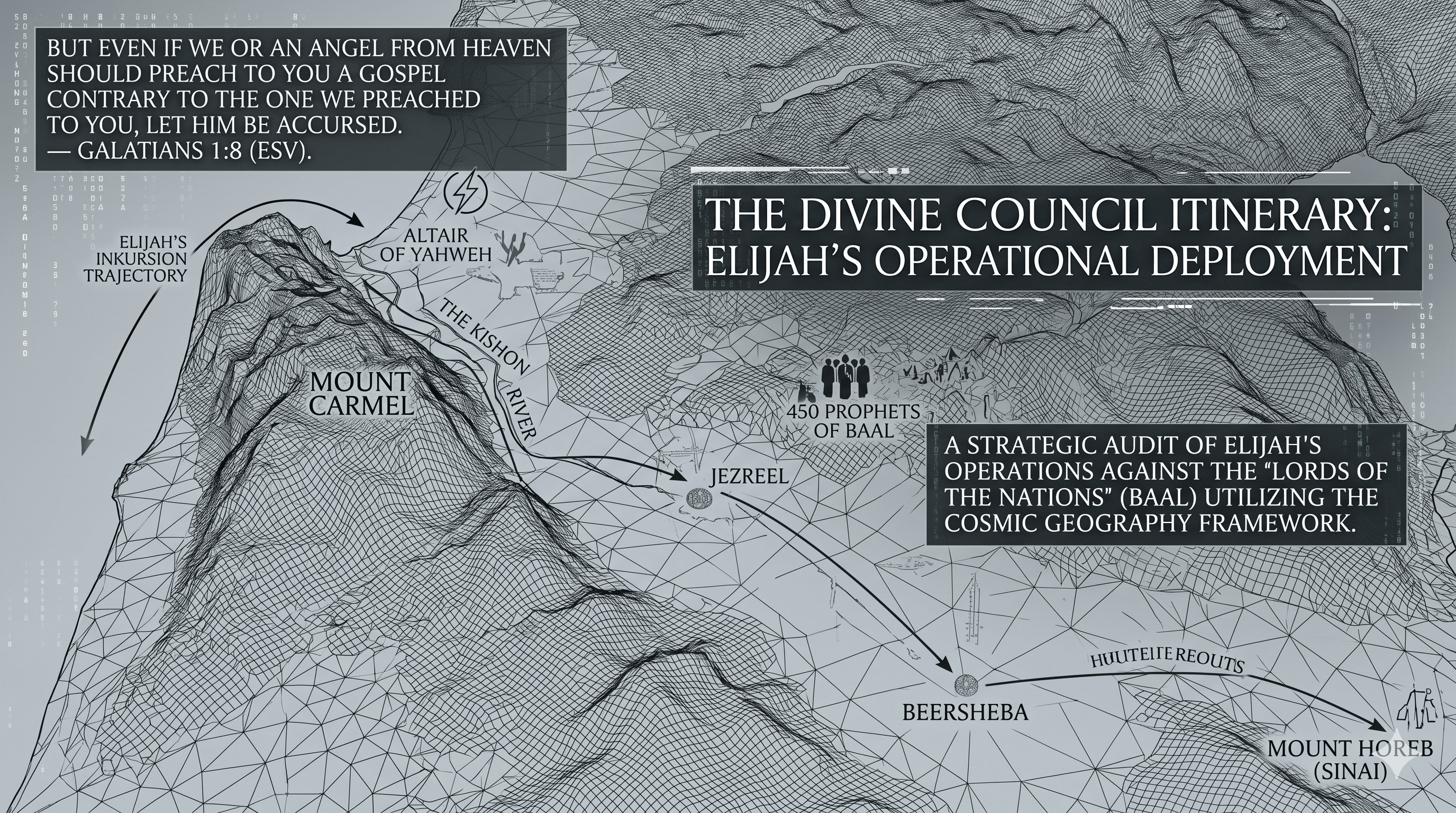
Using the late Dr. Michael Heiser’s Divine Council framework and the specific "cosmic geography" layout in Reversing Hermon, the story of Elijah in 1 Kings 18–19 transforms from a simple tale of a burnt-out prophet into a strategic military operation against the "lords of the nations."
In Heiser’s thesis, the world is divided into Cosmic Geography (Deuteronomy 32:8–9). Israel is Yahweh’s portion, while the other nations were assigned to lesser elohim (the Divine Council) who rebelled and became the "gods" of the nations—chief among them being Baal.
In Heiser’s thesis, the world is divided into Cosmic Geography (Deuteronomy 32:8–9). Israel is Yahweh’s portion, while the other nations were assigned to lesser elohim (the Divine Council) who rebelled and became the "gods" of the nations—chief among them being Baal.
>> OPERATIONAL POSTURE
Elijah operating as a kinetic agent in hostile territory
> II. Mount Carmel: The Direct Assault (1 Kings 18)
Significance: Carmel was situated on the border of Israel and Phoenicia (Baal’s "home turf"). Geographically, the Mount Carmel mountain range is a coastal mountain range in northern Israel stretching from the Mediterranean Sea towards the southeast. The range is approximately 6.5 to 8 kilometers (4.0 to 5.0 miles) wide, sloping with a steep face towards the southwest.
Heiser Overlay: This is a power encounter. By calling down fire, Yahweh isn't just proving He exists; He is publicly shaming Baal in front of his own council. In Canaanite myth, Baal was the "Lord of the Sky" and "Rider on the Clouds" who controlled lightning. Yahweh "steals" Baal's thunder, proving the Council member of that territory is a fraud.
Heiser Overlay: This is a power encounter. By calling down fire, Yahweh isn't just proving He exists; He is publicly shaming Baal in front of his own council. In Canaanite myth, Baal was the "Lord of the Sky" and "Rider on the Clouds" who controlled lightning. Yahweh "steals" Baal's thunder, proving the Council member of that territory is a fraud.
> III. Jezreel to Beersheba: The Retreat (1 Kings 19:1–3)
Significance: After Jezebel’s threat, Elijah flees to Beersheba. The distance from Jezreel to Beersheba is roughly 100 miles, a significant journey traversing the central highlands of Israel and entering the arid Negev desert in the south.
Heiser Overlay: Heiser often notes that Jezebel wasn't just a mean queen; she was the daughter of the high priest of Ethbaal. She represents the "seed of the serpent" attempting to reclaim the land for the rebel elohim. Elijah flees to the southernmost tip of "Yahweh’s land" (Beersheba).
Heiser Overlay: Heiser often notes that Jezebel wasn't just a mean queen; she was the daughter of the high priest of Ethbaal. She represents the "seed of the serpent" attempting to reclaim the land for the rebel elohim. Elijah flees to the southernmost tip of "Yahweh’s land" (Beersheba).
> IV. The Wilderness: The Transition (1 Kings 19:4–8)
Significance: Elijah enters the wilderness, is fed by an angel, and travels 40 days to Horeb. The journey from Beersheba to Mount Horeb (Sinai) is approximately 200 to 250 miles through desolate, unforgiving desert terrain.
Heiser Overlay: The wilderness is "chaos territory," the domain of Azazel or the demonic. Elijah is retracing the steps of the Exodus. He is being sustained by a loyal member of the Divine Council (the Angel) to prepare for a meeting with the Head of the Council.
Heiser Overlay: The wilderness is "chaos territory," the domain of Azazel or the demonic. Elijah is retracing the steps of the Exodus. He is being sustained by a loyal member of the Divine Council (the Angel) to prepare for a meeting with the Head of the Council.
> V. Mount Horeb: The Council Chambers (1 Kings 19:9–18)
Significance: Elijah arrives at the "Mountain of God." Mount Horeb is synonymous with Mount Sinai, a massive granite peak rising to 2,285 meters (7,497 feet) in the southern Sinai Peninsula.
Heiser Overlay: Horeb (Sinai) is a Cosmic Mountain. In the Ancient Near East, gods met on mountains. When Elijah hears the "low whisper" (qol dmamah daqqah), he isn't just hearing "peace"—he is standing in the Presence of the Council.
The Commission: God gives him a three-part hit list: Anoint Hazael (Syria), Jehu (Israel), and Elisha. Hazael is a foreign king. By commanding this, Yahweh is asserting that He—not the rebel gods of the nations—controls the destiny of Syria. This is a "Reversing Babel" move.
Heiser Overlay: Horeb (Sinai) is a Cosmic Mountain. In the Ancient Near East, gods met on mountains. When Elijah hears the "low whisper" (qol dmamah daqqah), he isn't just hearing "peace"—he is standing in the Presence of the Council.
The Commission: God gives him a three-part hit list: Anoint Hazael (Syria), Jehu (Israel), and Elisha. Hazael is a foreign king. By commanding this, Yahweh is asserting that He—not the rebel gods of the nations—controls the destiny of Syria. This is a "Reversing Babel" move.
> VI. Reversing Hermon: The "After" Impact
While Elijah’s primary itinerary ends at Horeb and then back to the Jordan, the Mount Hermon connection from Heiser’s Reversing Hermon thesis ties into the "Second Elijah" (John the Baptist/Jesus). Mount Hermon is a towering mountain cluster at the southern end of the Anti-Lebanon mountain range, with its summit straddling the border between Syria and Lebanon, reaching 2,814 meters (9,232 feet).
The Hermon Incursion: Hermon was the site where the Watchers (Genesis 6) allegedly descended to rebel.
The Transfiguration: In the New Testament, Jesus takes Peter, James, and John to a "high mountain"—which Heiser and many scholars argue was Mount Hermon.
The Meeting: Who appears with Jesus on the summit of the rebel's mountain? Elijah.
The Symbolic Strike: By appearing on Hermon with Elijah (the "Baal-slayer"), Jesus is declaring a formal "eviction notice" to the powers of darkness on their own headquarters.
The Hermon Incursion: Hermon was the site where the Watchers (Genesis 6) allegedly descended to rebel.
The Transfiguration: In the New Testament, Jesus takes Peter, James, and John to a "high mountain"—which Heiser and many scholars argue was Mount Hermon.
The Meeting: Who appears with Jesus on the summit of the rebel's mountain? Elijah.
The Symbolic Strike: By appearing on Hermon with Elijah (the "Baal-slayer"), Jesus is declaring a formal "eviction notice" to the powers of darkness on their own headquarters.
WHAT IS THE DIVINE COUNCIL?
This analysis provides a foundational look at the Divine Council framework Dr. Heiser developed, which is essential for understanding how he interprets the spiritual warfare occurring during Elijah's ministry.
> RELATED INTELLIGENCE DOSSIERS
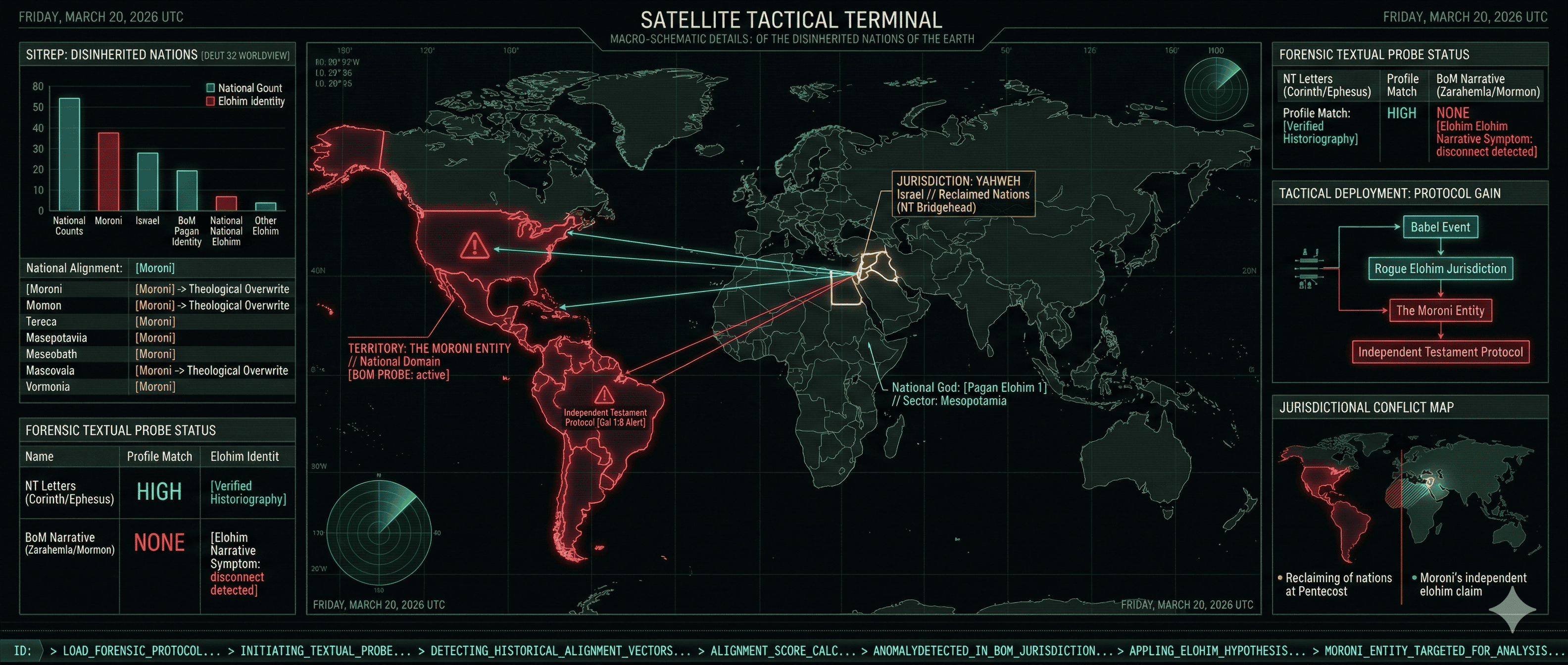
Latter-Day Saint Forensics: A Structural Audit. A comprehensive textual audit probing historical data structures, Bronze Age anomalies, and theological overwrites in LDS scripture.

Instructions from Jesus: System Protocols. Core operating instructions regarding prayer, threat detection, and the exclusive path of salvation.
> SYSTEM ARCHITECT




Lance Miller is the architect of lancemiller.org. His operational history includes a winter-over in Antarctica (Operation Deepfreeze '96, Congressional Medal), four years in the Alaskan fishing industry (Bering Sea, '99), and fighting the historic Biscuit Fire in the Siskiyou Mountains (2002). Holding a B.S. (2003), he later served as a Test Engineer on a technology team that won an Emmy Award (2008). Based in Seattle, he now merges Unix philosophy with theology to decode the Western Tradition.
[ X.COM PROFILE ]
[ X.COM PROFILE ]
[ TAP OPTIC TO CLOSE ]