DOCUMENT INIT
Below is a comprehensive dossier on the Hasmonean and Herodian dynasties. This timeline tracks the evolution of Judea from a revolutionary priest-state to a Roman client kingdom, ending with the total collapse of the Temple system in 70 CE.
// SYSTEM DIRECTORY: MODULE ACCESS
> I. The Hasmonean & Herodian Ruler Dossiers
MACCABEAN REVOLT (167–142 BCE)
Ruler (Key Examples)
Judas Maccabeus
Leadership Characteristics
Guerrilla leader; religious zealot; focused on Temple purification.
Economic & Cultural Profile
Economic: War-torn; high focus on reclaiming looted Temple assets. Cultural: Anti-Hellenistic.
Sadducee / Religious Profile
Sadducees: Not yet a formalized sect; the "Zadokite" priestly line was being displaced.
EARLY HASMONEAN (142–104 BCE)
Ruler (Key Examples)
Simon Thassi, John Hyrcanus I
Leadership Characteristics
Diplomatic; expansionist; combined the High Priesthood with civil rule.
Economic & Cultural Profile
Economic: Expansion of trade; Judea becomes a regional power. Cultural: Emergence of "Jewish Hellenism."
Sadducee / Religious Profile
Sadducees: Formalized as the elite priestly party; Hyrcanus breaks with Pharisees to align with them.
HASMONEAN PEAK/DECAY (103–63 BCE)
Ruler (Key Examples)
Alexander Jannaeus, Salome Alexandra
Leadership Characteristics
Jannaeus: Tyrannical, militaristic. Alexandra: Pious, pro-Pharisee.
Economic & Cultural Profile
Economic: Mercenary armies drained the treasury. Cultural: Deep civil strife between sects.
Sadducee / Religious Profile
Sadducees: Reached peak political power under Jannaeus; were persecuted under Alexandra.
THE HERODIAN RISE (37–4 BCE)
Ruler (Key Examples)
Herod the Great
Leadership Characteristics
Brilliant builder; paranoid; ruthless; Roman puppet.
Economic & Cultural Profile
Economic: Massive taxation for building projects (Temple, Masada). Cultural: Forced Romanization.
Sadducee / Religious Profile
Sadducees: Politically neutered; Herod appointed "outsider" High Priests to control them.
HERODIAN TETRARCHY (4 BCE–66 CE)
Ruler (Key Examples)
Herod Antipas, Agrippa I & II
Leadership Characteristics
Bureaucratic; survivalist; increasingly disconnected from the people.
Economic & Cultural Profile
Economic: High unemployment; agrarian distress; heavy Roman tribute. Cultural: Growing "Zealot" movement.
Sadducee / Religious Profile
Sadducees: Cooperated with Rome to maintain Temple stability; rejected the afterlife (per Matthew 22:23 ESV).
> II. Timeline of Sovereignty and Destruction
- 167 BCE: The Maccabean Revolt begins.
- 164 BCE: Rededication of the Temple (Hanukkah).
- 140 BCE: Simon Thassi confirmed as "Leader and High Priest forever," establishing the Hasmonean Dynasty.
- 63 BCE: Pompey the Great enters Jerusalem; Judea becomes a Roman protectorate.
- 37 BCE: Herod the Great captures Jerusalem with Roman aid, ending Hasmonean rule.
- 19 BCE: Herod begins the massive expansion of the Second Temple.
- 6–4 BCE: Birth of Jesus Christ during the final years of Herod the Great.
- 66 CE: Outbreak of the First Jewish-Roman War.
- 70 CE: Siege of Jerusalem; Destruction of the Second Temple by Titus.
- 73 CE: Fall of Masada; final disbanding of the Jewish state until 1948.
> III. Land Holding Trends: The Shift in Ownership
A critical trend during this period was the consolidation of land into the hands of a few, which fueled the social unrest seen in the New Testament.
The Hasmonean Era (Jewish/Nationalist)
Land was largely held by Jewish families and the Temple estate. Small-scale farming was the norm, though the Hasmonean royal family seized vast tracts of conquered territory in Galilee and Perea.
The Herodian Era (Greco-Roman/Elite)
Herod the Great confiscated the estates of the Hasmonean aristocracy. He redistributed land to his loyalists and foreign supporters. This led to the rise of Latifundia (large estates) owned by the "Herodian" elite, while commoners became tenant farmers or day laborers.
The Roman Era (Imperial)
Following the revolt in 70 CE, the land was declared Ager Publicus (Roman public land). The Emperor Vespasian claimed Judea as his personal property, leasing it back to those who could pay, effectively ending traditional Jewish land inheritance.
> IV. The Sadducees: Tracking the Profile of Power
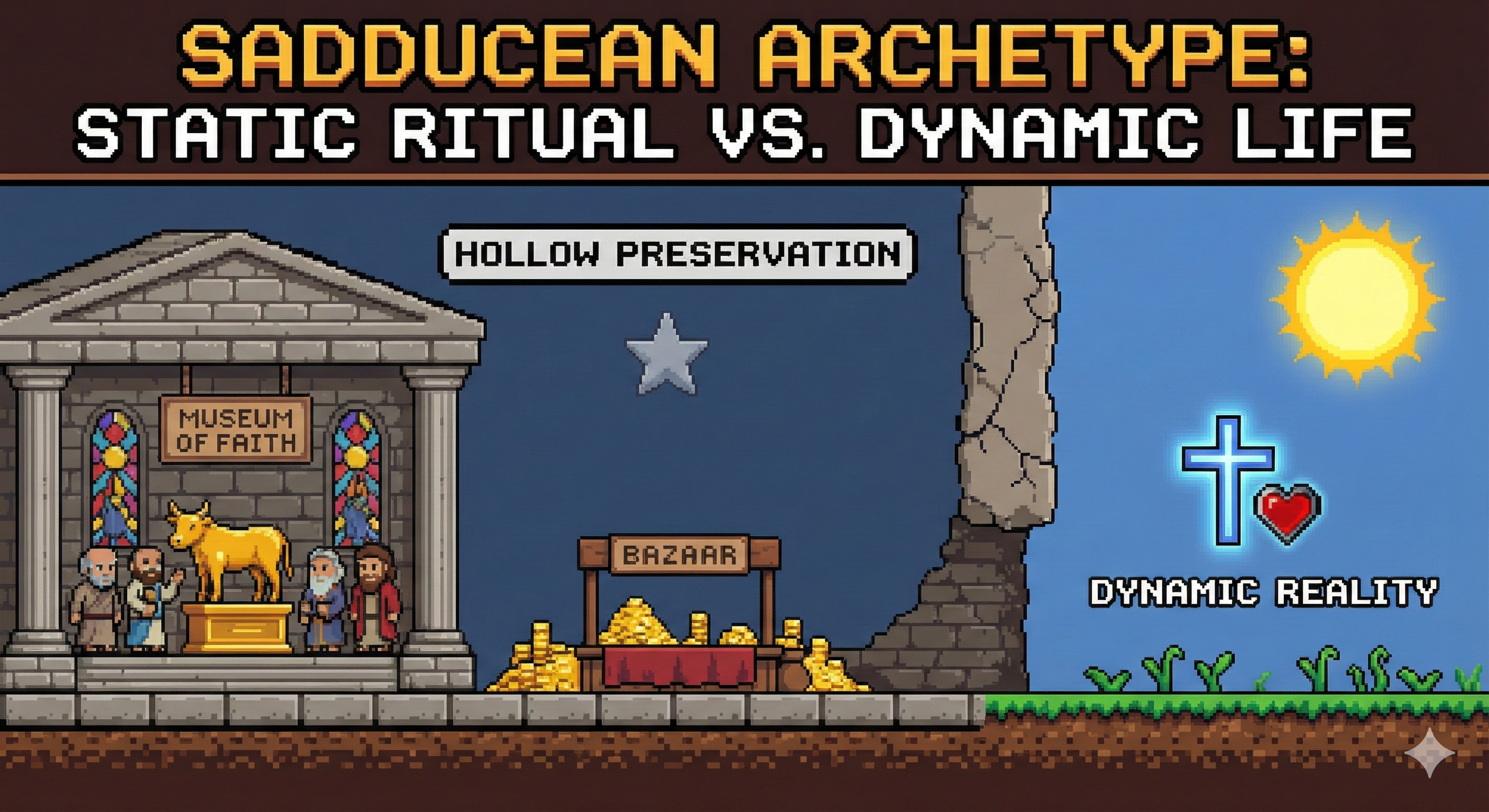
The Sadducees were defined by their relationship to the Temple and Rome.
- Origins: They emerged from the wealthy, priestly aristocracy who believed the "Oral Law" of the Pharisees was an innovation.
- The Hasmonean Pivot: Initially, they were the "establishment" that the Maccabees fought against. However, they successfully co-opted the Hasmonean kings, becoming the official party of the court and the Temple.
- The Herodian Squeeze: Herod the Great viewed the Sadducees as a threat to his power. He stripped them of their ancestral right to the High Priesthood, making the office an appointment he could sell or trade.
- The Roman Alliance: In the time of Jesus, the Sadducees were the "status quo" party. They feared any messianic uprising because it threatened the delicate peace with Rome.
"If we let him go on like this, everyone will believe in him, and the Romans will come and take away both our place and our nation."
— John 11:48 (ESV)
The End
Because the Sadducees' identity was tied exclusively to the Temple and its sacrifices, they vanished from history after 70 CE. Unlike the Pharisees, who transitioned into Rabbinic Judaism, the Sadducees had no theological framework that survived the loss of the Temple.
> RELATED INTELLIGENCE DOSSIERS
> SYSTEM ARCHITECT




Lance Miller is the architect of lancemiller.org. His operational history includes a winter-over in Antarctica (Operation Deepfreeze '96, Congressional Medal), four years in the Alaskan fishing industry (Bering Sea, '99), and fighting the historic Biscuit Fire in the Siskiyou Mountains (2002). Holding a B.S. (2003), he later served as a Test Engineer on a technology team that won an Emmy Award (2008). Based in Seattle, he now merges Unix philosophy with theology to decode the Western Tradition.
[ X.COM PROFILE ]
[ X.COM PROFILE ]
[ TAP OPTIC TO CLOSE ]