Forensic Audit: The Fall of Jericho
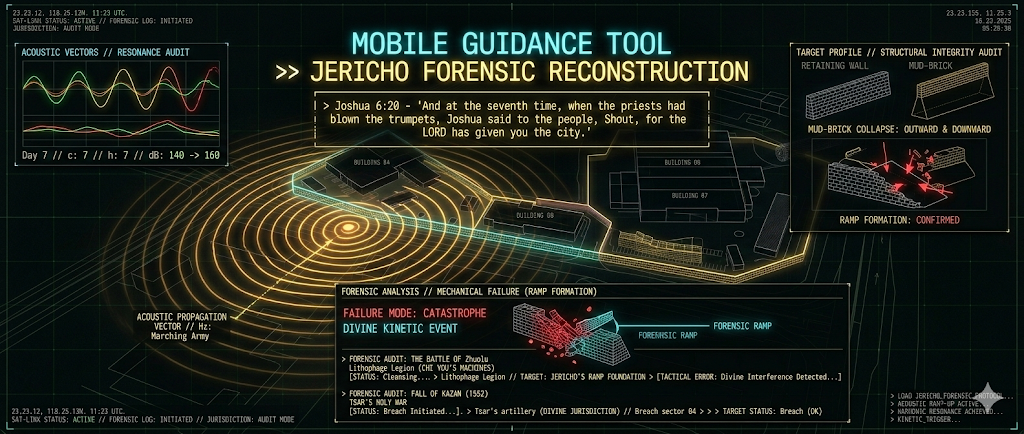
The siege of Jericho is frequently relegated to the realm of Sunday school myth—a simplistic story of marching and blowing horns. However, a forensic analysis of the text, combined with modern archaeological findings, reveals a highly sophisticated, multi-domain tactical operation. It was a perfectly executed campaign combining psychological warfare, acoustic resonance, and targeted kinetic intervention.
// 01. The Architectural Target
Jericho was not a sprawling metropolis; it was a heavily fortified military and administrative outpost controlling the entrance to the Canaanite highlands. Archaeological excavations (such as those by Kathleen Kenyon and Bryant Wood) reveal a formidable double-walled defensive system.
The base was a massive stone retaining wall, approximately 12 to 15 feet high. Atop this stone foundation sat a mud-brick wall extending another 20 to 26 feet into the air. A secondary mud-brick wall was positioned further up the embankment. To breach the city, an invading infantry force would have to scale the steep retaining wall under heavy fire, only to face the sheer vertical face of the mud-brick fortifications.
The base was a massive stone retaining wall, approximately 12 to 15 feet high. Atop this stone foundation sat a mud-brick wall extending another 20 to 26 feet into the air. A secondary mud-brick wall was positioned further up the embankment. To breach the city, an invading infantry force would have to scale the steep retaining wall under heavy fire, only to face the sheer vertical face of the mud-brick fortifications.
// 02. The Acoustic Vector
The biblical text specifically mandates the use of seven shofars (ram's horns) carried by seven priests, rather than standard silver military trumpets. The shofar is not designed for complex melodies; it produces a raw, low-frequency, high-amplitude waveform.
Acoustically, a battle-grade shofar produces a fundamental frequency ranging between 130 Hz and 200 Hz. When seven priests blow these horns simultaneously, the slight, natural phase variations in their pitch create "beat frequencies"—a low-frequency, pulsating acoustic throb. At close range, this wall of sound would register between 110 dB and 120 dB.
When blown continuously over a period of days, these instruments emit a droning resonance. In the context of a siege, this sustained low-frequency vibration serves both as a psychological pressure mechanism against the defenders and as a physical acoustic primer directed at the rigid, sun-baked mud-brick structures.
Acoustically, a battle-grade shofar produces a fundamental frequency ranging between 130 Hz and 200 Hz. When seven priests blow these horns simultaneously, the slight, natural phase variations in their pitch create "beat frequencies"—a low-frequency, pulsating acoustic throb. At close range, this wall of sound would register between 110 dB and 120 dB.
When blown continuously over a period of days, these instruments emit a droning resonance. In the context of a siege, this sustained low-frequency vibration serves both as a psychological pressure mechanism against the defenders and as a physical acoustic primer directed at the rigid, sun-baked mud-brick structures.
TACTICAL ASSET: THE ARK OF THE COVENANT
The procession was anchored by the Ark of the Covenant. In the ancient Near East, kings took the idols of their gods into battle to ensure victory. By placing the Ark in the center of the formation, Yahweh was establishing Himself as the supreme military commander—the "Lord of Hosts"—leading the vanguard of the assault.
// 03. Geological Variables: The Jordan Rift Valley
To understand the mechanics of the wall's collapse, one must factor in the specific environmental constraints of the target zone. Jericho sits directly on the Dead Sea Transform (DST), a massive, active tectonic fault line that forms the boundary between the African and Arabian plates.
The city was built on an alluvial fan, an environment highly susceptible to seismic amplification. In modern geotechnical engineering, this phenomenon is known as the "site effect." When a tectonic slip occurs along the DST, the loose, sandy soil of the Jordan Rift Valley can behave like a liquid—a process known as soil liquefaction. During such an event, the foundation loses its shear strength, transferring immense kinetic energy directly into the structures above.
The city was built on an alluvial fan, an environment highly susceptible to seismic amplification. In modern geotechnical engineering, this phenomenon is known as the "site effect." When a tectonic slip occurs along the DST, the loose, sandy soil of the Jordan Rift Valley can behave like a liquid—a process known as soil liquefaction. During such an event, the foundation loses its shear strength, transferring immense kinetic energy directly into the structures above.
// 04. Psychological Siege Dynamics
For six days, the Israelite infantry was ordered into absolute silence. "You shall not shout or make your voice heard, neither shall any word go out of your mouth..." (Joshua 6:10).
This discipline achieved two critical objectives. First, it instilled an eerie, unnerving dread within the walls of Jericho. Standard ancient warfare was loud—filled with war cries, weapon clashing, and taunts. The synchronized, silent marching of thousands of men, punctuated only by the droning of the shofars, broke the psychological paradigm of the Canaanite defenders.
Second, it established a predictable operational rhythm. By marching exactly one circuit per day and returning to camp, the Israelites conditioned the enemy to expect a specific pattern of behavior.
This discipline achieved two critical objectives. First, it instilled an eerie, unnerving dread within the walls of Jericho. Standard ancient warfare was loud—filled with war cries, weapon clashing, and taunts. The synchronized, silent marching of thousands of men, punctuated only by the droning of the shofars, broke the psychological paradigm of the Canaanite defenders.
Second, it established a predictable operational rhythm. By marching exactly one circuit per day and returning to camp, the Israelites conditioned the enemy to expect a specific pattern of behavior.
// 05. The Kinetic Trigger (Day 7)
On the seventh day, the tactical pattern was violently disrupted. Instead of a single circuit, the formation marched around the city seven times. The psychological exhaustion of the defenders, forced to maintain high alert for hours as the marching continued relentlessly, reached its peak.
At the culmination of the seventh circuit, the operational silence was broken by a synchronized, massive kinetic event: the sustained, maximum-volume blast of the horns coupled with the unified shout of the entire infantry. A human shout can register at 90-100 dB, but the combined vocalization of tens of thousands of infantrymen, synchronized with the horns, acts logarithmically. The acoustic pressure wave would have spiked to an estimated 140 to 160 dB.
Acoustic-Seismic Coupling: The sudden introduction of this massive frequency wave served as the final catalyst. Six days of low-frequency droning had micro-fractured the mortar and stressed the retaining wall's integrity. When the acoustic wave hit its absolute peak, it perfectly coincided with a localized, divinely orchestrated seismic shear wave running through the Jordan Rift fault. The acoustic vibration "fluidized" the brittle mud-brick just enough for the seismic event to shatter it instantly. The structures suffered catastrophic, simultaneous failure.
At the culmination of the seventh circuit, the operational silence was broken by a synchronized, massive kinetic event: the sustained, maximum-volume blast of the horns coupled with the unified shout of the entire infantry. A human shout can register at 90-100 dB, but the combined vocalization of tens of thousands of infantrymen, synchronized with the horns, acts logarithmically. The acoustic pressure wave would have spiked to an estimated 140 to 160 dB.
Acoustic-Seismic Coupling: The sudden introduction of this massive frequency wave served as the final catalyst. Six days of low-frequency droning had micro-fractured the mortar and stressed the retaining wall's integrity. When the acoustic wave hit its absolute peak, it perfectly coincided with a localized, divinely orchestrated seismic shear wave running through the Jordan Rift fault. The acoustic vibration "fluidized" the brittle mud-brick just enough for the seismic event to shatter it instantly. The structures suffered catastrophic, simultaneous failure.
FORENSIC OUTCOME: THE RAMP
The archaeology perfectly matches the biblical account. The text states the wall "fell down flat" (literally, "fell beneath itself"). The mud-brick walls atop the stone retaining wall collapsed outward and downward. This rubble created a perfect, naturally formed ramp leading up over the stone foundation, allowing the Israelite infantry to surge straight up and into the city, bypassing the defensive architecture entirely.