// SYSTEM DIRECTORY: MODULE ACCESS
[ I ] GENESIS 14: GEOPOLITICAL CONTEXT
[ II ] THE VALLEY MEETING
[ III ] WHO IS MELCHIZEDEK?
[ IV ] TITHE & OATH
[ V ] NEW TESTAMENT LOGIC: CHRIST'S SOLE PRIESTHOOD
[ VI-VII ] LDS LOGIC: A WILDLY DIVERGENT PARADIGM (DELEGATING TO MEN THE UNIQUE, SOLELY HELD PRIESTHOOD OF THE SON OF GOD)
[ VIII ] LOGICAL COMPARISON
> I. Genesis 14: The Geopolitical Context
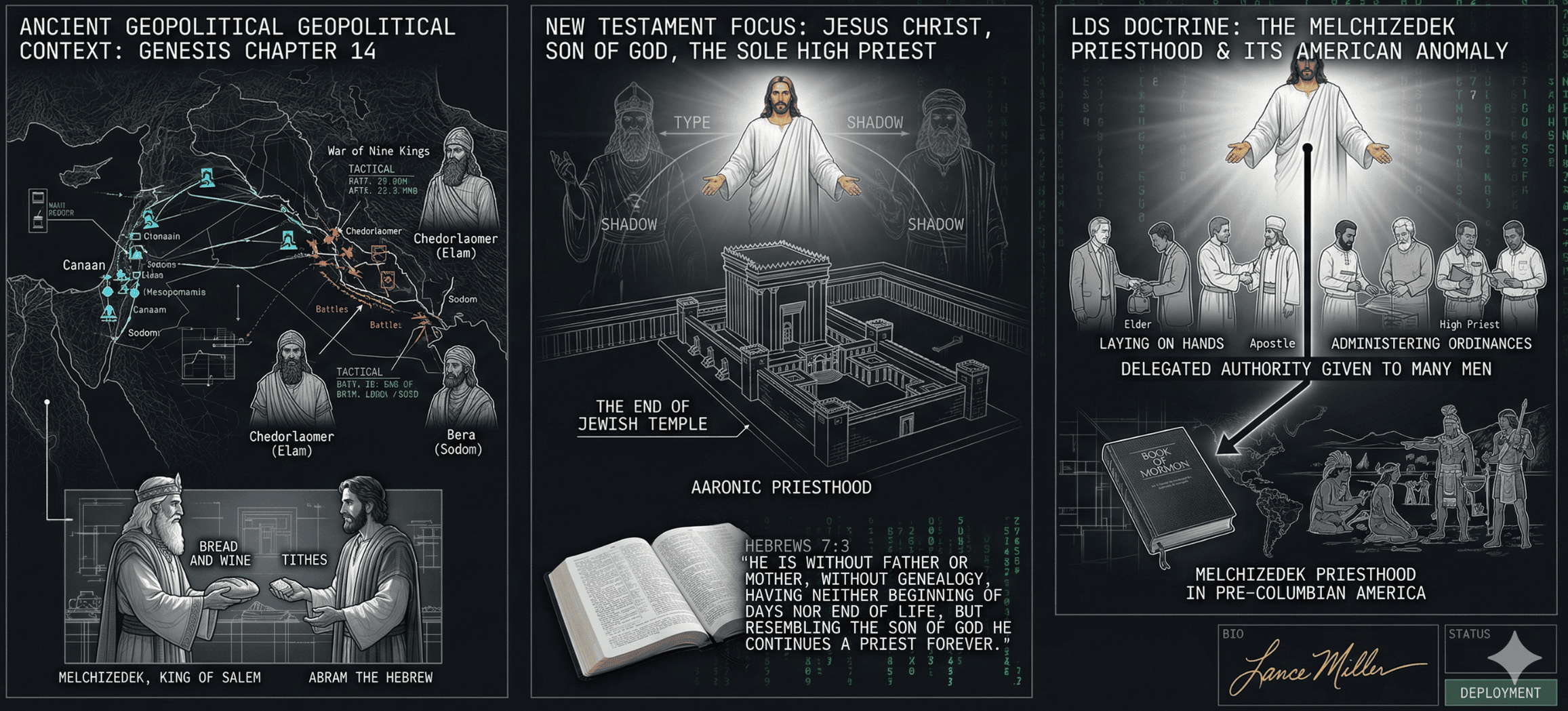
The "War of the Nine Kings" provides the backdrop for Melchizedek's appearance. It is a conflict of imperial dominance versus local rebellion.
The Power Players & Locations
The Mesopotamian Alliance (The Overlords):
- Chedorlaomer (Elam): The primary hegemon (Modern-day SW Iran).
- Amraphel (Shinar): Associated with Babylon.
- Arioch (Ellasar): Likely Larsa/Southern Mesopotamia.
- Tidal (Goiim): "King of Nations," likely Hittite or nomadic coalitions.
The Pentapolis Rebellion (The Tributaries):
- Kings of Sodom, Gomorrah, Admah, Zeboiim, and Bela (Zoar). Located in the Valley of Siddim (The Salt Sea).
Abram’s Tactical Alliance (The Neutrals-turned-Combatants):
- Abram the Hebrew: Based at the Oaks of Mamre (Hebron).
- The Amorite Trio: Mamre, Eshcol, and Aner. These were local chieftains and "allies of Abram" (Genesis 14:13).
Timeline of the Conflict
- Year 1–12: The Pentapolis serves Chedorlaomer.
- Year 13: The Pentapolis rebels.
- Year 14: Chedorlaomer’s punitive expedition sweeps through the Transjordan, defeating the Rephaim and Amalekites before hitting the Valley of Siddim.
- The Rout: The kings of Sodom and Gomorrah flee; Lot is captured.
- The Rescue: Abram mobilizes 318 trained men, pursues them to Dan, and executes a night raid, chasing them to Hobah (north of Damascus), recovering all people and goods.
> II. The Meeting in the King's Valley
Upon Abram's victorious return, he is met in the Valley of Shaveh (the King's Valley) by two distinct figures representing two different kingdoms and paradigms.
The Dual Reception
- Bera, King of Sodom: The secular, defeated king. He operates on a transactional logic: "Give me the persons, but take the goods for yourself" (Gen 14:21).
- Melchizedek, King of Salem: The mysterious priest-king. He operates on a sacramental logic. He brings "bread and wine" and pronounces a blessing, attributing the victory not to Abram’s tactics, but to God Most High.
> III. Who is Melchizedek?
Name and Titles
- Name: Melek (King) + Tzedek (Righteousness). "King of Righteousness."
- Title 1: King of Salem (Shalom). "King of Peace." Salem is universally understood to be ancient Jerusalem (Psalm 76:2).
- Title 2: Priest of God Most High (El Elyon). He is the first person in scripture to hold the title "Priest" (kohen). He serves the supreme Creator God, not a local pantheon deity.
The Anomalies
In Genesis, a book obsessed with genealogies ("these are the generations of..."), Melchizedek has no recorded father, mother, birth, or death. He simply steps onto the page as a fully formed King and Priest, interacts with Abram, and steps off.
> IV. The Tithe and the Oath
Abram recognizes Melchizedek's superior spiritual authority and gives him a tenth (a tithe) of all the spoils.
Abram then refuses the King of Sodom’s transactional offer, explicitly adopting Melchizedek’s theology. Abram swears an oath: "I have lifted my hand to the LORD [Yahweh], God Most High [El Elyon], Possessor of heaven and earth..." (Gen 14:22). He merges his covenant God (Yahweh) with the title used by Melchizedek (El Elyon).
Abram then refuses the King of Sodom’s transactional offer, explicitly adopting Melchizedek’s theology. Abram swears an oath: "I have lifted my hand to the LORD [Yahweh], God Most High [El Elyon], Possessor of heaven and earth..." (Gen 14:22). He merges his covenant God (Yahweh) with the title used by Melchizedek (El Elyon).
> V. The New Testament Logic (Hebrews 7)
The author of Hebrews uses the historical account of Melchizedek to construct a massive theological argument proving that Jesus Christ is a superior High Priest to the Levitical (Aaronic) priesthood.
1. The Argument of Silence
Hebrews takes the Genesis anomaly (no genealogy) and turns it into a theological "type" or shadow. Because Melchizedek has no recorded beginning or end, he resembles the eternal Son of God (Heb 7:3).
2. The Superiority of the Priesthood
The lesser always blesses the greater, and the lesser pays tithes to the greater. Since Levi was "still in the loins of his ancestor" (Abraham), the entire Levitical priesthood conceptually bowed and paid tithes to the Melchizedek priesthood. Therefore, Melchizedek’s order is greater than Aaron’s (Heb 7:4-10).
3. The Replacement of the Law
If perfection could have been attained through the Levitical priesthood (which the Law of Moses was based on), why would God promise another priest to arise "after the order of Melchizedek" (Psalm 110:4)?
"For when there is a change in the priesthood, there is necessarily a change in the law as well" (Heb 7:12).
Because Jesus is from the tribe of Judah (not Levi), He claims the priesthood not by legal descent, but "by the power of an indestructible life" (Heb 7:16). He is the guarantor of a better covenant.
"For when there is a change in the priesthood, there is necessarily a change in the law as well" (Heb 7:12).
Because Jesus is from the tribe of Judah (not Levi), He claims the priesthood not by legal descent, but "by the power of an indestructible life" (Heb 7:16). He is the guarantor of a better covenant.
APOSTOLIC PROTOCOL: Hebrews 7 is a very clear and complete teaching from an Apostle on the topic of Melchizedek. It establishes that the role of priest is singular to only one, the eternal living Son of Man. This priesthood is eternal, single to only one being, and wholly superior.
> VI. The Latter-day Saint (LDS) Logic
In Latter-day Saint theology, "Melchizedek" is not merely a unique historical figure or a typological shadow of Christ. Rather, the "Melchizedek Priesthood" is a specific, transferable order of divine authority that is conferred upon worthy male members of the church today.
Core LDS Concepts
- The Restoration of Authority: LDS theology teaches that this priesthood was lost from the earth during the Great Apostasy and restored in 1829 by the apostles Peter, James, and John to Joseph Smith.
- The Two Priesthoods: The church operates on two levels: The "Aaronic Priesthood" (lesser, preparatory ordinances like baptism) and the "Higher Priesthood" (The Melchizedek Priesthood), originally called the "Holy Priesthood, after the Order of the Son of God." The name was changed to avoid the "too frequent repetition" of God's name (D&C 107:2-4).
- Ecclesial Function: It is the authority by which the Church is led, including roles such as Apostle, Seventy, High Priest, Elder, and Patriarch.
- Historical Detail (JST Genesis 14): LDS scripture adds that Melchizedek was a man of great faith who "wrought righteousness" and "stopped the mouths of lions."
> VII. The American Hemisphere (LDS Doctrine)
Latter-day Saint (LDS) doctrine explicitly teaches that a Melchizedek-related priesthood existed in the Americas among the peoples described in the Book of Mormon (the Nephites and Jaredites) long before Columbus. Because the Nephites were descendants of the tribe of Joseph (not Levi), they were not genealogically eligible for the Aaronic/Levitical priesthood as it was practiced in the Old Testament. Therefore, LDS theology posits that their authority must have been the "Higher Priesthood"—the Melchizedek Priesthood.
The Logical Necessity
LDS leaders and scholars use a specific logic to explain why this priesthood existed in the pre-Columbian Americas:
- Non-Levite Lineage: Since Lehi (the patriarch who left Jerusalem) was of the lineage of Manasseh, his descendants could not hold the Levitical priesthood.
- Performance of Ordinances: The Book of Mormon records these people performing baptisms, offering sacrifices, and ordaining "priests and teachers."
- The Conclusion: To perform these acts legitimately, they must have held the Melchizedek Priesthood, which is not restricted by lineage.
Key Scriptural Evidence (Alma 13)
The most significant discourse on this topic is found in Alma 13. This chapter provides an "extrabiblical" expansion of the Melchizedek tradition:
- The "Holy Order": Alma refers to the priesthood as being "after the holy order, which was after the order of [God's] Son." In LDS terminology, this is synonymous with the Melchizedek Priesthood.
- Historical Precedent: Alma cites the biblical Melchizedek as the supreme historical example of this order, noting that Melchizedek's people were once wicked but repented because of his high-priestly ministry.
- Foreordination: Alma 13 teaches that those who hold this priesthood in the Americas (and elsewhere) were "called and prepared from the foundation of the world" based on their "exceeding faith and good works" in a pre-mortal existence.
The Role of the "High Priest"
In the Book of Mormon, the office of "High Priest" (such as held by Alma the Elder and Alma the Younger) is viewed by LDS commentators as a specific office within the Melchizedek Priesthood.
- Ecclesiastical Governance: These high priests presided over the Church in the Americas, a role that mirrors the modern LDS office of the President of the High Priesthood.
- Consecration: Jacob (Nephi’s brother) records that he was "consecrated" as a priest and teacher "after the manner of [God's] holy order" (2 Nephi 6:2), which LDS scholars like Bruce R. McConkie identified as Melchizedek authority.
> VIII. Logical Comparison: NT vs. LDS
| Feature | New Testament Logic (Hebrews) | LDS Logic (Book of Mormon/D&C/Alma) |
|---|---|---|
| Singularity / Priesthood Holders | Focused on the Unique and Sole high-priesthood of Jesus. Only Jesus (the anti-type). | Focused on the Delegated authority given to many men (prophets, high priests). |
| Purpose / Function | To prove the Mosaic Law is obsolete. To replace the temporary Law of Moses. | To provide the "power of godliness" in church ordinances. To coexist with and empower the Law of Moses in a non-Levite setting. |
| Accessibility / Transferability | Christ is the only High Priest of this order. "Untransferable" because Jesus lives forever. | All worthy male members may be ordained. Transferable through the "laying on of hands" by authorized leaders. |
| Logic of Title | Melchizedek is a "type" or shadow of Christ. | Melchizedek is a historical holder of a transferable office. |
THE STARK CONTRAST
In the New Testament logic, the Melchizedek priesthood is an argument for the exclusivity of Christ—He is the only one qualified because He lives forever.
In LDS logic, the Melchizedek priesthood is an argument for the inclusivity of divine authority—it is a restoration of an ancient order meant to be held by men to perform saving ordinances (Baptism of the Spirit, Temple rites).
In LDS logic, the Melchizedek priesthood is an argument for the inclusivity of divine authority—it is a restoration of an ancient order meant to be held by men to perform saving ordinances (Baptism of the Spirit, Temple rites).
In short, for Latter-day Saints, Melchizedek is not just a mysterious figure in Genesis; he is the namesake of the authority that allowed Nephite prophets to act as legal administrators of God's power in the Western Hemisphere for a thousand years.
> RELATED INTELLIGENCE DOSSIERS
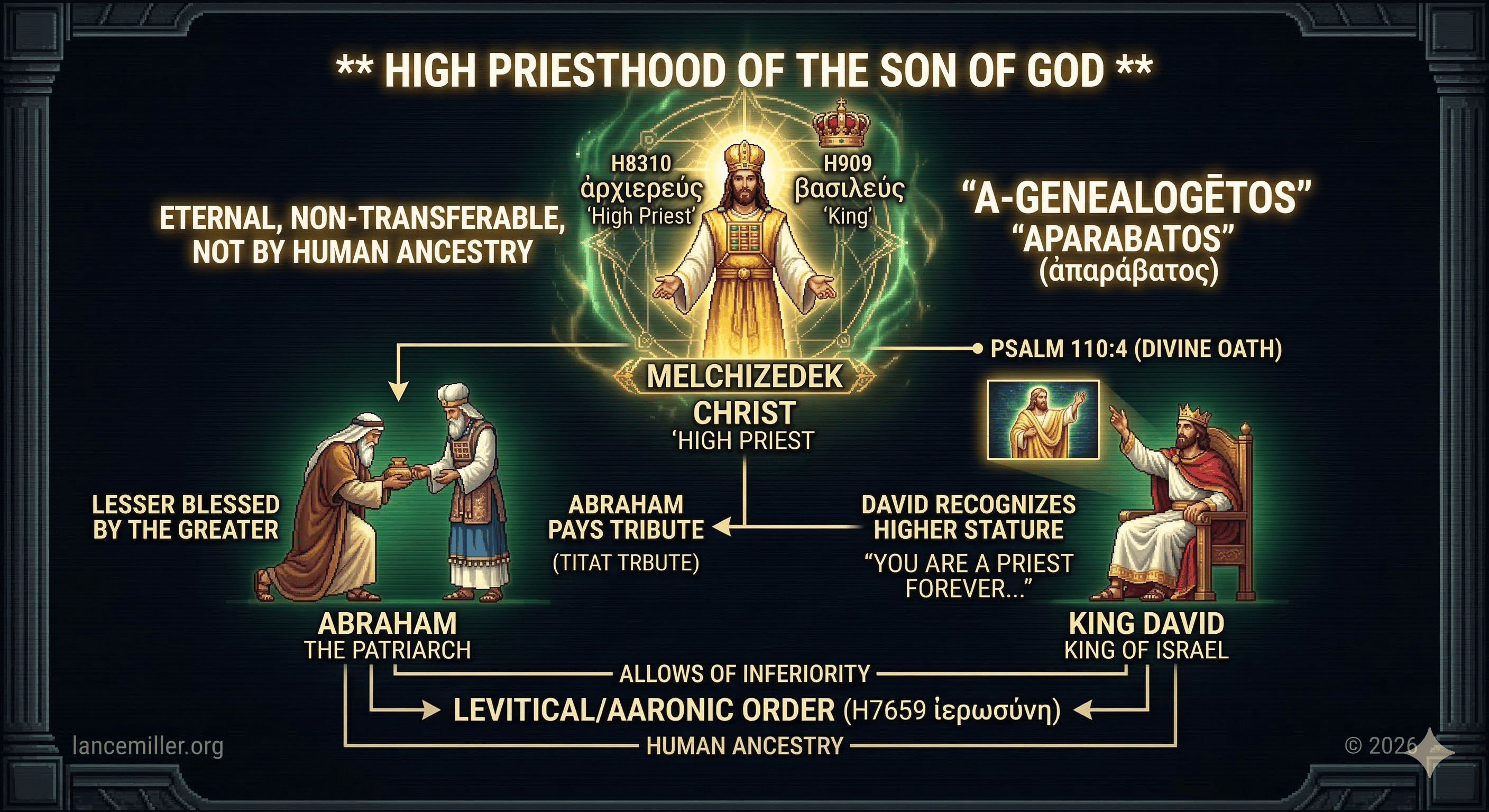
Hebrews 7 Source: An analysis of the singular and eternal priesthood of the Son of Man.
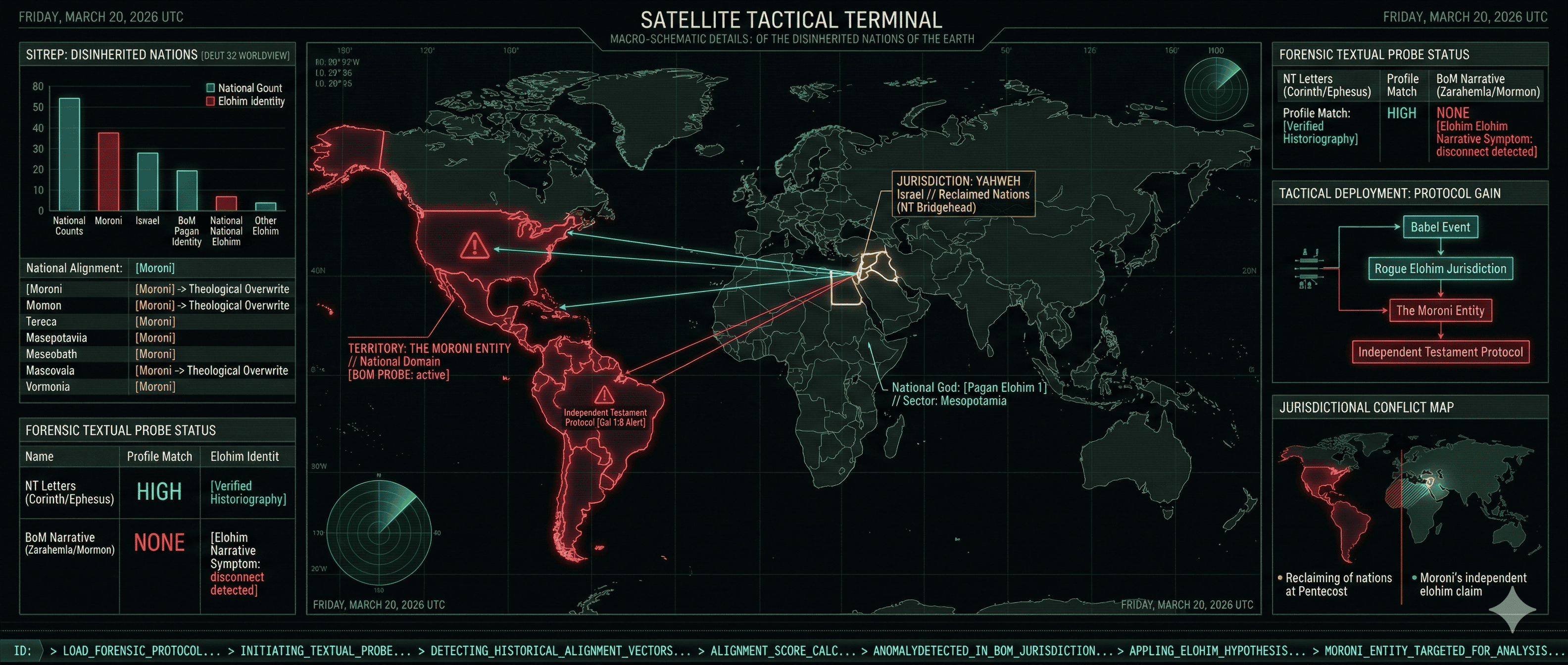
Latter-Day Saint Forensics: A Structural Audit. A comprehensive textual audit probing historical data structures, Bronze Age anomalies, and theological overwrites in LDS scripture.

Instructions from Jesus: System Protocols. Core operating instructions regarding prayer, threat detection, and the exclusive path of salvation.
> SYSTEM ARCHITECT




Lance Miller is the architect of lancemiller.org. His operational history includes a winter-over in Antarctica (Operation Deepfreeze '96, Congressional Medal), four years in the Alaskan fishing industry (Bering Sea, '99), and fighting the historic Biscuit Fire in the Siskiyou Mountains (2002). Holding a B.S. (2003), he later served as a Test Engineer on a technology team that won an Emmy Award (2008). Based in Seattle, he now merges Unix philosophy with theology to decode the Western Tradition.
[ X.COM PROFILE ]
[ X.COM PROFILE ]
[ TAP OPTIC TO CLOSE ]