EXECUTIVE SUMMARY
This report analyzes the specific fuel supply scenarios for three major West Coast nodes in the current 2026-2027 climate. The West Coast is a "geographically isolated" energy market where state policies and the lack of trans-continental pipelines create a unique, high-cost environment.
// SYSTEM DIRECTORY: MODULE ACCESS
> I. Part 1: Fuel Supply Scenarios
Scenario A: Seattle & Washington State ("The Northern Gate")
Washington is the only West Coast state with a direct pipeline connection to Canadian crude (Trans Mountain), giving it a slight logistical advantage over California.
- Annual Consumption: ~115 Million Barrels (Refined Products)
- Monthly Average: ~9.6 Million Barrels
- Supply Sources:
- Canada (via Pipeline): 45% – Primarily heavy and light crude from Alberta.
- Alaska (via Tanker): 40% – Alaska North Slope (ANS) crude.
- Rail (Bakken): 10% – High-volatility light crude from North Dakota.
- Foreign Imports: 5% – Occasional cargoes from Asia or South America.
Scenario B: Los Angeles & San Francisco (California) ("The Foreign Dependent Hub")
California is the most isolated market. With in-state production falling 70% since its 1986 peak, it now relies on foreign tankers for the majority of its fuel.
- Annual Consumption: ~488 Million Barrels (Crude Processing Capacity)
- Monthly Average: ~40.7 Million Barrels
- Supply Sources:
- Foreign Imports: 61% – (Approx. 30% from the Persian Gulf, balance from Ecuador/Guyana).
- California Domestic: 23% – Mostly heavy crude from the San Joaquin Valley.
- Alaska (via Tanker): 16% – Declining share as ANS production matures.
Scenario C: Portland (Oregon) ("The End of the Line")
Oregon has zero oil refineries. It is entirely dependent on the Olympic Pipeline (bringing fuel south from Washington refineries) and marine barges.
- Annual Consumption: ~35 Million Barrels (Refined Products)
- Monthly Average: ~2.9 Million Barrels
- Supply Sources:
- Washington State Refineries: 85% – Via the Olympic Pipeline and Columbia River barges.
- Global Imports: 10% – Refined gasoline/diesel arriving at the Port of Portland from Asia.
- Renewable Blends: 5% – High state mandates for renewable diesel and ethanol.
> II. Part 2: Historical Thwarting of Pipelines
The most significant "missing link" in U.S. energy infrastructure is a crude oil pipeline from the Permian Basin (Texas) to the West Coast.
The Kinder Morgan "Freedom Pipeline" (2012-2013)
- The Plan: A $2 billion project to convert an existing natural gas line and build new segments to move 277,000 barrels of Texas crude per day to California refineries.
- The Thwarting: The project was scrapped in 2013 due to a "lack of commercial interest" from California refiners, but the deeper cause was a "regulatory wall." Environmental groups and California policymakers signaled that any new crude infrastructure would face decades of litigation under CEQA (California Environmental Quality Act), making the capital risk untenable.
The Trans Mountain Expansion (TMX)
- The Plan: To triple the capacity of the line from Alberta to the BC/Washington border.
- The Thwarting: While now operational, it was delayed for a decade by activists and the BC provincial government. This delay forced Washington refineries to rely more on expensive rail and tankers rather than stable pipe-fed Canadian oil.
> III. Part 3: Transport Costs & Pump Price Impact
The method of transport is the primary "invisible tax" on West Coast fuel.
| Transport Method | Estimated Cost per Barrel | Impact on Pump Price (approx.) |
|---|---|---|
| Pipeline | $5.00 | Lowest: Most stable prices; seen in WA/Midwest. |
| Tanker (Foreign) | $8.00 - $12.00 | Variable: Subject to global shipping rates and "Hormuz surcharges." |
| Rail (Bakken) | $12.00 - $15.00 | High: Used when pipelines are full; adds ~15-20¢ per gallon. |
| Truck | $20.00+ | Extreme: Only used for short distances/emergencies. |
The "Refinery Gap": In 2026, the closure of the Phillips 66 Wilmington and Valero Benicia refineries has forced the West Coast to import finished gasoline from India and South Korea. Importing finished fuel is significantly more expensive than importing crude, as it requires specialized "product tankers" and bypasses local industrial efficiencies.
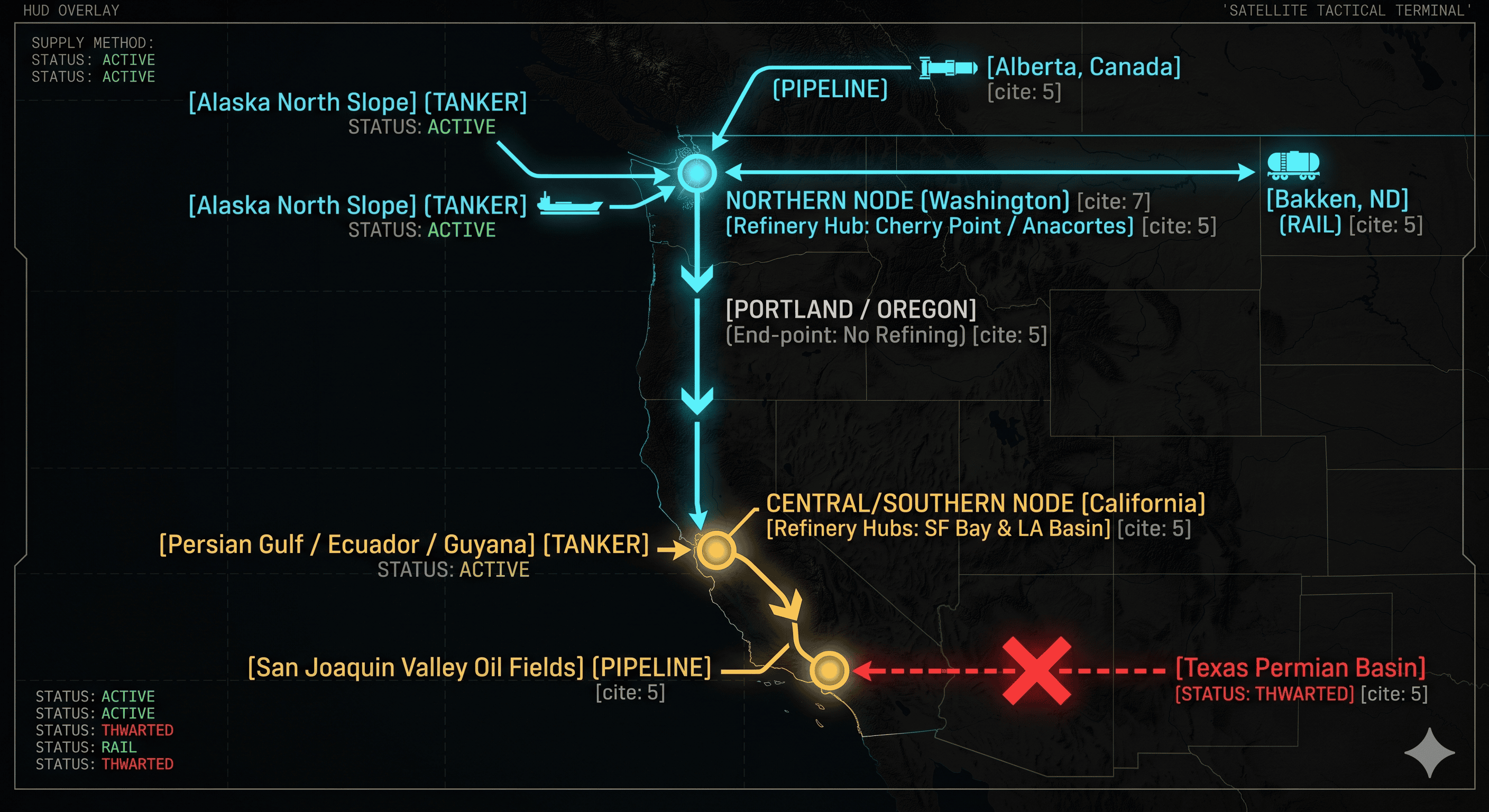
> IV. West Coast Energy Node Map (Conceptual)
NORTHERN NODE (Washington)
[ Refinery Hub: Cherry Point / Anacortes ]
|
|<--- (PIPELINE) --- [ Alberta, Canada ]
|<--- (TANKER) --- [ Alaska North Slope ]
|<--- (RAIL) --- [ Bakken, ND ]
|
V
[ PORTLAND / OREGON ] (End-point: No Refining)
|
|
CENTRAL/SOUTHERN NODE (California)
[ Refinery Hubs: SF Bay & LA Basin ]
|
|<--- (TANKER) --- [ Persian Gulf / Ecuador / Guyana ]
|<--- (PIPELINE) --- [ San Joaquin Valley Oil Fields ]
|
X --- (BLOCKED) --- [ Texas Permian Basin ]
KEY DATA POINT
As of April 2026, the "last tankers" from the Persian Gulf that departed before the blockade are currently offloading in Long Beach. By May 2026, the supply gap will need to be filled by high-cost rail or South American imports, likely keeping Seattle and LA prices above $5.50/gal through the summer.
> SYSTEM ARCHITECT
Lance Miller is the architect of lancemiller.org. His operational history includes a winter-over in Antarctica (Operation Deepfreeze '96, Congressional Medal), four years in the Alaskan fishing industry (Bering Sea, '99), and fighting the historic Biscuit Fire in the Siskiyou Mountains (2002). Holding a B.S. (2003), he later served as a Test Engineer on a technology team that won an Emmy Award (2008). Based in Seattle, he now merges Unix philosophy with theology to decode the Western Tradition.
[ X.COM PROFILE ]
[ X.COM PROFILE ]
[ TAP OPTIC TO CLOSE ]