Part I: The Lords of the Sea
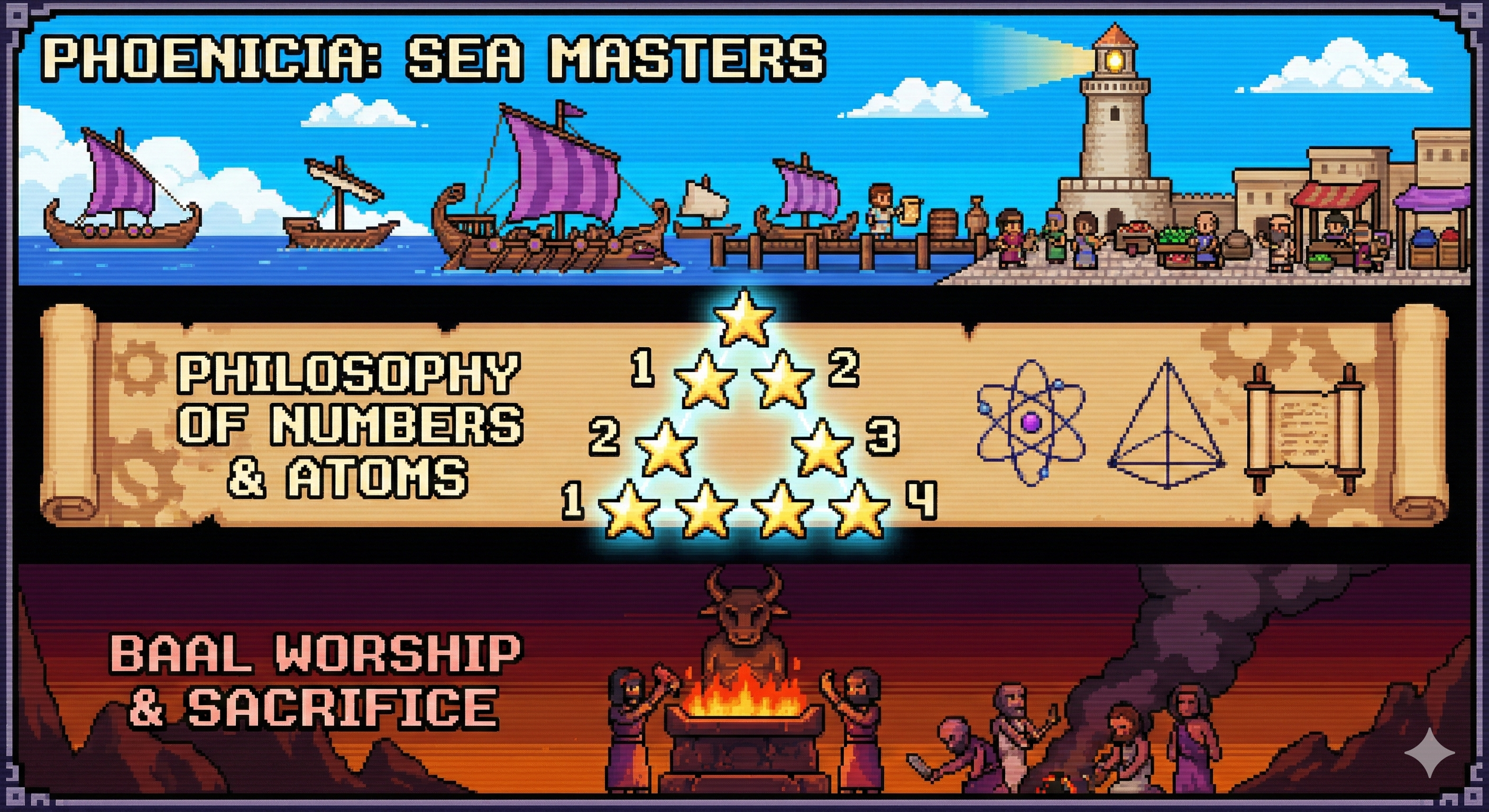
Long before the rise of Athens or Rome, the Phoenicians (Canaanites) dominated the Mediterranean. Centered in the cities of Tyre, Sidon, and Byblos in modern-day Lebanon, they were not conquerors of land, but masters of the waves. Their legacy is built on the "Cedar and the Sea."
The Society of Merchant Princes
Unlike the landed aristocracies of Greece or Rome, Phoenician power was uniquely mercantile. In cities like Tyre, the "middle class" of traders was not a sub-stratum; they were the ruling elite.
- Oligarchic Rule: Power resided in Councils of Elders or Senates composed of the wealthiest merchant families. While kings existed, their power was checked by these commercial interests.
- The Purple People: They were famous for "Tyrian Purple," a dye made from murex snails so expensive it became the universal symbol of royalty.
- Technological Vanguard: They gave the West the phonetic alphabet (22 characters), advanced shipbuilding, and the first "global" trade network, reaching as far as Britain and arguably circumnavigating Africa.
The Phoenicians were a paradox. They were technologically advanced and commercially brilliant, yet their religious practices—specifically the worship of Baal and Astarte—included rituals of human sacrifice and temple prostitution. Some historians argue these rituals served as a form of "conditioning," separating the elite initiates from universal moral laws to foster a hardened, mercantile ruthlessness.
Part II: The Strategic Hardware (Cedar & Ships)
Before we can understand the "software" of Phoenician philosophy, we must understand the "hardware" that made their dominance possible. The Phoenician civilization sat at the foot of Mount Lebanon, the exclusive source of the ancient world's most strategic resource.
SYSTEM CONCEPT: The Asymmetric Resource Cascade
This is the defining academic framework for Phoenician dominance. It describes a feedback loop where a single geological monopoly creates a chain of unassailable advantages:
1. MONOPOLY RESOURCE (Cedar) →
2. SUPERIOR TECHNOLOGY (Long-Range Ships) →
3. EXTENDED RANGE (Atlantic Travel) →
4. EXCLUSIVE INTEL (The World-Picture) →
5. HEGEMONY (Wealth & Power)
Engineering Superiority: The Cedar Advantage
In a world of mud-brick and scrub pine, the Cedars of Lebanon (*Cedrus libani*) were an industrial miracle. The quantitative advantage was overwhelming:
| Resource | Properties | Naval Limit |
|---|---|---|
| Egyptian Acacia | Short, knotty, brittle. Max length ~4 meters. | River barges. Ships required complex "splicing" and rope trusses to keep from snapping in half. |
| Lebanese Cedar | Straight, dense, oil-rich (rot-proof). Max height 40 meters. | Single-piece keels and masts. Capable of surviving high-torque Atlantic swells. |
The Single-Piece Mast & Ocean Survival
The difference between a 4-meter log and a 40-meter log is the difference between a coastal hopper and an ocean conqueror. Because Phoenicians could mill single-piece masts and full-length keels, their ships possessed a structural integrity unknown to the Egyptians or early Greeks.
- Torque Resistance: In high seas, a ship twists. A spliced hull (like Egyptian river boats) leaks or snaps under this torque. A cedar-keeled ship flexes and holds.
- Sail Area: A taller, stronger single-piece mast supports a larger sail area, translating to higher speeds and the ability to outrun pursuit.
The Inversion Principle: From Hull to Temple
The engineering logic of the Phoenicians created a direct link between their navy and their architecture. They understood a fundamental structural truth: A roof is just a boat turned upside down.
The "mortise and tenon" joinery required to make a ship's hull watertight under the pressure of the sea is the exact same skill required to make a temple roof watertight under the pressure of the rain. When King Hiram of Tyre sent his engineers to help Solomon build the Temple in Jerusalem (1 Kings 5-6), they weren't just carpenters; they were naval architects applying their trade to stone and cedar. The Temple of God was built with the technology of the sea.
Part III: The Intelligence Monopoly
The most colossal advantage generated by the "Resource Cascade" was not wealth, but Information. The Phoenicians operated an intelligence network that rivaled a modern agency like the CIA.
The "CIA" of the Ancient World
Because their ships could go where others could not (Britain for tin, the Baltic for amber, round Africa for gold), they possessed a map of the world that was invisible to land-bound empires.
- Asymmetric Knowledge: They knew where the resources were. They knew the wind patterns. They knew the political state of distant tribes. To an Egyptian or Babylonian, the world ended at the horizon; to a Phoenician, the horizon was just a transit point.
- Disinformation Campaigns: To protect their monopoly, they actively spread disinformation. They invented myths of sea monsters and "boiling seas" at the Pillars of Hercules (Gibraltar) to terrify Greek and Roman competitors into staying in the Mediterranean.
- Strategic Arbitrage: By knowing the price of tin in Cornwall and the price of bronze in Babylon, they could engage in arbitrage on a continental scale, buying low in the unknown world and selling high in the known world.
Part IV: The Lost Philosophy
History often credits the Greeks with the "invention" of philosophy, but the roots dig deeper into Phoenician soil. Much of what is called "Pre-Socratic" thought has distinct parallels in the older wisdom of Sidon and Byblos.
Mochus of Sidon: The Digital Atomist
Long before Democritus, the Phoenician sage Mochus of Sidon (sometimes Moschus) proposed an atomic theory. However, his view differed from later materialists:
- Digital Atomism: Mochus did not see atoms merely as chunks of matter, but as entities defined by number and measure.
- The Soul as Number: If the fundamental building blocks of reality are immutable "digital" entities, then the soul itself is such an entity. This provided a logical framework for immortality and reincarnation—the soul is a non-decaying unit of the cosmos.
Part V: Pythagoras the Phoenician?
Pythagoras is the bridge between the ancient East and the emerging West. While typically called an Ionian Greek from Samos, ancient sources paint a more complex picture of his heritage.
The Ancestry Debate
Was he Greek or Phoenician? The Neoplatonists (Porphyry, Iamblichus) provide detailed accounts suggesting a strong Levantine connection:
- Father: Mnesarchus, described variously as a gem-engraver or a wealthy merchant from Tyre (Phoenicia).
- Birth: Born on Samos, but into a family with deep roots in the East.
- Education: It is said he was not just a tourist but an initiate. He didn't just visit the East; he returned to his ancestral roots to find the "Ancient Mysteries."
Part VI: The Great Itinerary
Disillusioned with the tyranny of Polycrates on Samos and hungry for the "primal wisdom," Pythagoras left Greece around age 18. His journey reads like a grand tour of the ancient intellectual world.
| Location | The Teachers | The Lesson |
|---|---|---|
| Phoenicia (Sidon, Byblos, Tyre) |
Prophets & Hierophants | Initiated into the local Mysteries. Learned the ritual purity and the separation from the mundane world. |
| Egypt (Memphis, Thebes) |
Priests of Amun | Spent 22 years here. Learned geometry, astronomy, and the discipline of silence. He reportedly underwent circumcision to enter the inner sanctuaries. |
| Babylon (Chaldea) |
The Magi | Taken as a "guest/captive" by Cambyses. Spent 12 years learning the "perfect numbers," music theory, and the movement of the stars. |
Part VII: The Pythagorean Way (*Bios Pythagorikos*)
Settling in Croton (Southern Italy), Pythagoras did not form a school in the modern sense, but a brotherhood—a cult of math and ethics.
"All is Number"
This was the central maxim. Unlike Thales (who thought the world was water), Pythagoras saw the world as a matrix of numerical relationships.
*
* *
* * *
* * * *
1 + 2 + 3 + 4 = 10 (Perfection)
Part VIII: The Legacy in Athens
Pythagoras died, but his "software" ran on. The true heir to his synthesis was Plato.
The Academy as a Pythagorean Lodge?
Plato founded his Academy in 387 BC in a sacred olive grove. While not a strict monastery like Croton, the DNA was Pythagorean:
- The Inscription: "Let no one ignorant of geometry enter here."
- The Curriculum: Heavy focus on mathematics as the prelude to philosophy.
- The Philosophy: Plato’s "Theory of Forms" is essentially a modification of Pythagoras’s "Theory of Numbers." The abstract, unchanging world of Forms is the world of the Pythagorean Monad.
The Phoenician Connection to Stoicism
The story comes full circle with Zeno of Citium (Cyprus). A Phoenician by descent, Zeno founded Stoicism in Athens.
Stoicism can be seen as the "ethical correction" to the darker side of Phoenician culture. Where the old Tyrian religion involved chaotic passions and blood sacrifice, Zeno’s Stoicism emphasized Logos (Universal Reason) and absolute self-control. It was the Phoenician intellect finally purifying itself from the Phoenician superstition, creating the moral framework that would later guide the Roman Empire.