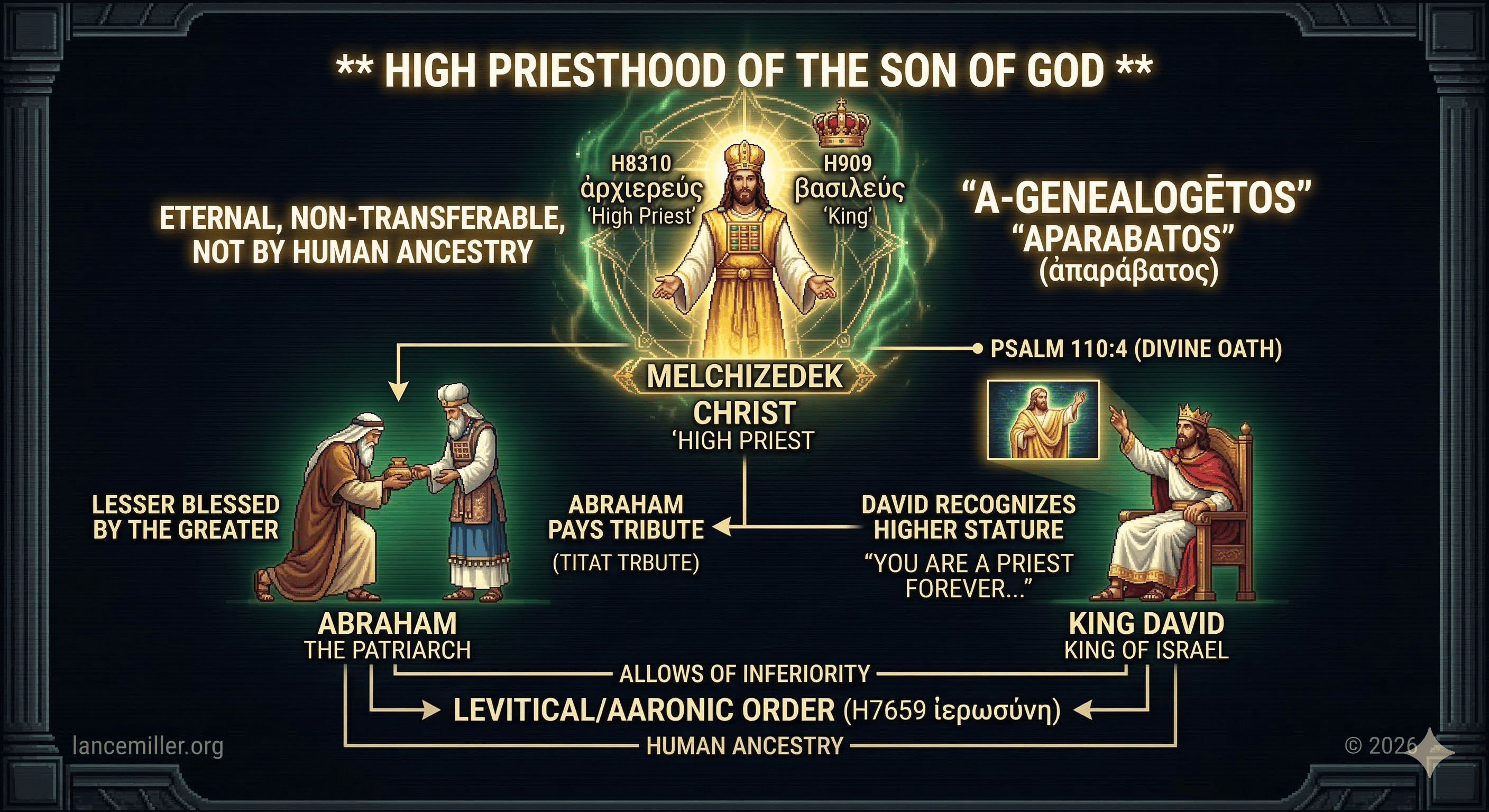
Son of Man as Priest and King
The Unification of Sovereign Authority and Intercessory Priesthood
[ ⚡ DEPLOY OPERATIONS CAPITAL ]
// SUSTAIN THE SIGNAL //
SYSTEM ARCHITECTURE OVERVIEW:
The New Testament reveals a singular messianic profile that integrates three distinct offices: Prophet, Priest, and King. While the Levitical system separated civil and religious authority, the "Order of Melchizedek" represents a higher, prehistoric, and eternal jurisdiction that unifies these powers.
Primary Thesis: Jesus Christ fulfills the Melchizedekian type not by tribal descent, but by the power of an indestructible life, serving as the unique, non-transferable High Priest who simultaneously occupies the throne of David.
Primary Thesis: Jesus Christ fulfills the Melchizedekian type not by tribal descent, but by the power of an indestructible life, serving as the unique, non-transferable High Priest who simultaneously occupies the throne of David.
// I. THE HIERARCHICAL ORDER OF MELCHIZEDEK
In the standard biblical framework, the Melchizedekian order is defined by its superiority over the Levitical (Aaronic) priesthood. This is not merely a different title, but a higher hierarchical rank based on antiquity and the nature of the office.
"The Lord has sworn and will not change his mind, 'You are a priest forever after the order of Melchizedek.'"
Psalm 110:4 (ESV)
CORE HIERARCHICAL ANALYSIS:
1. Divine Appointment: Unlike Levites who inherited office by blood, this order is established by a divine oath.
2. Superiority to Abraham: Melchizedek blessed Abraham and received tithes from him. In the ancient hierarchy, the lesser is always blessed by the greater.
3. Indestructibility: This priesthood is "forever," contrasting with mortal priests who must be replaced upon death.
2. Superiority to Abraham: Melchizedek blessed Abraham and received tithes from him. In the ancient hierarchy, the lesser is always blessed by the greater.
3. Indestructibility: This priesthood is "forever," contrasting with mortal priests who must be replaced upon death.
| OFFICE ATTRIBUTE | SYSTEMIC FUNCTION |
|---|---|
| Melek-Tzedek King of Righteousness |
Establishes the moral foundation of the throne; the King must first be righteous. |
| Melek-Salem King of Peace |
The result of righteousness; a sovereign rule that ends conflict. |
| A-Genealogētos Without Genealogy |
Indicates the office is not dependent on human ancestry (Levi/Aaron) but on divine selection. |
// II. LATTER-DAY SAINT TECHNICAL SCHEMA
The Church of Jesus Christ of Latter-day Saints (LDS) presents a highly structured, modern administrative application of the Melchizedek Priesthood. While they honor the ancient Melchizedek as a "great high priest," they define the order as the "Holy Priesthood, after the Order of the Son of God," renamed to avoid the frequent repetition of the name of the Supreme Being.
LDS ADMINISTRATIVE RANKINGS:
In the LDS schema, the Melchizedek Priesthood is the "Greater Priesthood" and contains several specific offices organized into quorums:
* Elder: The entry-level office for adult men; authorized to confer the Holy Ghost. * High Priest: Responsible for spiritual welfare and presiding roles (Bishops, Stake Presidents). * Patriarch: An office dedicated to giving "Patriarchal Blessings" to members. * Seventy: "Especial witnesses" who work under the Apostles to regulate the Church globally. * Apostle: The highest governing body; holders of all "priesthood keys" for the earth.
* Elder: The entry-level office for adult men; authorized to confer the Holy Ghost. * High Priest: Responsible for spiritual welfare and presiding roles (Bishops, Stake Presidents). * Patriarch: An office dedicated to giving "Patriarchal Blessings" to members. * Seventy: "Especial witnesses" who work under the Apostles to regulate the Church globally. * Apostle: The highest governing body; holders of all "priesthood keys" for the earth.
SYSTEMIC CLASH / DIFFERENCES:
The LDS technical schema diverges from the traditional biblical interpretation in several critical sectors:
1. Transferability vs. Uniqueness: Traditional exegesis of Hebrews 7:24 argues Christ holds a priesthood that is aparabatos—untouchable or non-transferable. The LDS system is built on the distribution of this priesthood to all worthy male members.
2. Genealogy vs. Merit: While Hebrews emphasizes Melchizedek's lack of genealogy to show Christ's independence from the Law, LDS doctrine utilizes the priesthood as a routinized, institutional authority structure with clear lineages of ordination ("Line of Authority").
3. The "Oath and Covenant": LDS theology introduces a specific "Oath and Covenant of the Priesthood" (derived from D&C 84) that a man makes when receiving the office, whereas the biblical text focuses on the God's oath to the Messiah.
1. Transferability vs. Uniqueness: Traditional exegesis of Hebrews 7:24 argues Christ holds a priesthood that is aparabatos—untouchable or non-transferable. The LDS system is built on the distribution of this priesthood to all worthy male members.
2. Genealogy vs. Merit: While Hebrews emphasizes Melchizedek's lack of genealogy to show Christ's independence from the Law, LDS doctrine utilizes the priesthood as a routinized, institutional authority structure with clear lineages of ordination ("Line of Authority").
3. The "Oath and Covenant": LDS theology introduces a specific "Oath and Covenant of the Priesthood" (derived from D&C 84) that a man makes when receiving the office, whereas the biblical text focuses on the God's oath to the Messiah.
> SYSTEM ARCHITECT




Lance Miller is the architect of lancemiller.org. His operational history includes a winter-over in Antarctica (Operation Deepfreeze '96, Congressional Medal), four years in the Alaskan fishing industry (Bering Sea, '99), and fighting the historic Biscuit Fire in the Siskiyou Mountains (2002). Holding a B.S. (2003), he later served as a Test Engineer on a technology team that won an Emmy Award (2008). Based in Seattle, he now merges Unix philosophy with theology to decode the Western Tradition.
[ X.COM PROFILE ]
[ X.COM PROFILE ]