
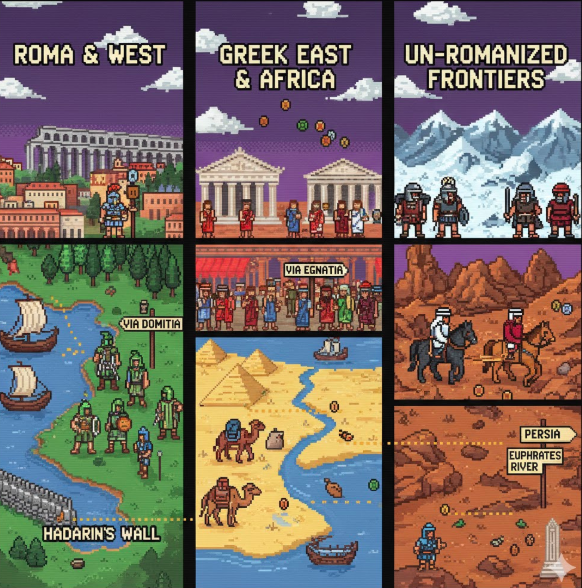
The Edge of Empire: Diversity and Boundaries
The Roman Empire was never a monolithic cultural entity. Its massive geographic reach, particularly in the centuries after Augustus, necessitated the integration of countless distinct ethnic groups, languages, and belief systems. The concept of the "Roman citizen" evolved dramatically, transitioning from a narrow legal status into a broad cultural identity that flourished along the volatile borders, or limites, of the Empire.
1. The Spectrum of Integration and Identity
Roman identity was more about legal status and shared civic duty than about ethnic origin. Provinces exhibited a spectrum of integration:
- Core Latinized Regions (Italy, Hispania, Gallia Narbonensis): These areas rapidly adopted Latin, Roman law, and urban structures, leading to a high degree of cultural assimilation (Romanitas).
- Hellenic East (Greece, Asia Minor, Egypt): These regions maintained their dominant Greek language and sophisticated Hellenistic culture. Rome governed them, but Greek cultural superiority often dictated the local form of Roman rule.
- The Frontier Zones (Britannia, Germania, Dacia): Integration here was primarily driven by the military. Local tribes provided auxiliary soldiers, adopting Roman military culture and earning citizenship, which then filtered back into their communities.
2. The Significance of the Limes (Boundaries)
The limes—the linear, fortified boundaries like Hadrian's Wall or the German Limes—were not simply defensive barriers but porous economic and cultural zones. They were points of profound Constructive Selection (referencing your file on the topic), where Roman technology and administration were constantly tested against barbarian strength, forcing innovation and adaptation.
- Economic Exchange: Trade frequently crossed the limes, often enriching both Roman frontier communities and neighboring tribes.
- Military Diversity: The legions stationed on the limes were composed of men from all corners of the Empire, creating melting-pot communities where Egyptian soldiers might garrison Britain, and Germanic auxiliaries might patrol Syria.
- Cultural Fluidity: Roman and local cultures intermingled, leading to unique hybrid art, religion (e.g., the cult of Mithras), and burial practices distinct from the Roman heartland.
Conclusion on the Edge: The greatest ethnic and cultural innovation within the Roman Empire often occurred not in the marble cities of Italy, but in the gritty, multi-ethnic camps and civilian settlements clustered along the edges of the civilized world.
3. The Edict of Caracalla (212 AD) and Universal Citizenship
The distinction between Roman and non-Roman was largely obliterated by the Constitutio Antoniniana (Edict of Caracalla), which granted full Roman citizenship to nearly all free inhabitants of the Empire. This act solidified the notion of a universal, multi-ethnic Roman identity, effectively concluding the process of political assimilation that had begun centuries earlier.