The Iron Fist of Rome
The Economics of Galilee: First Century CE
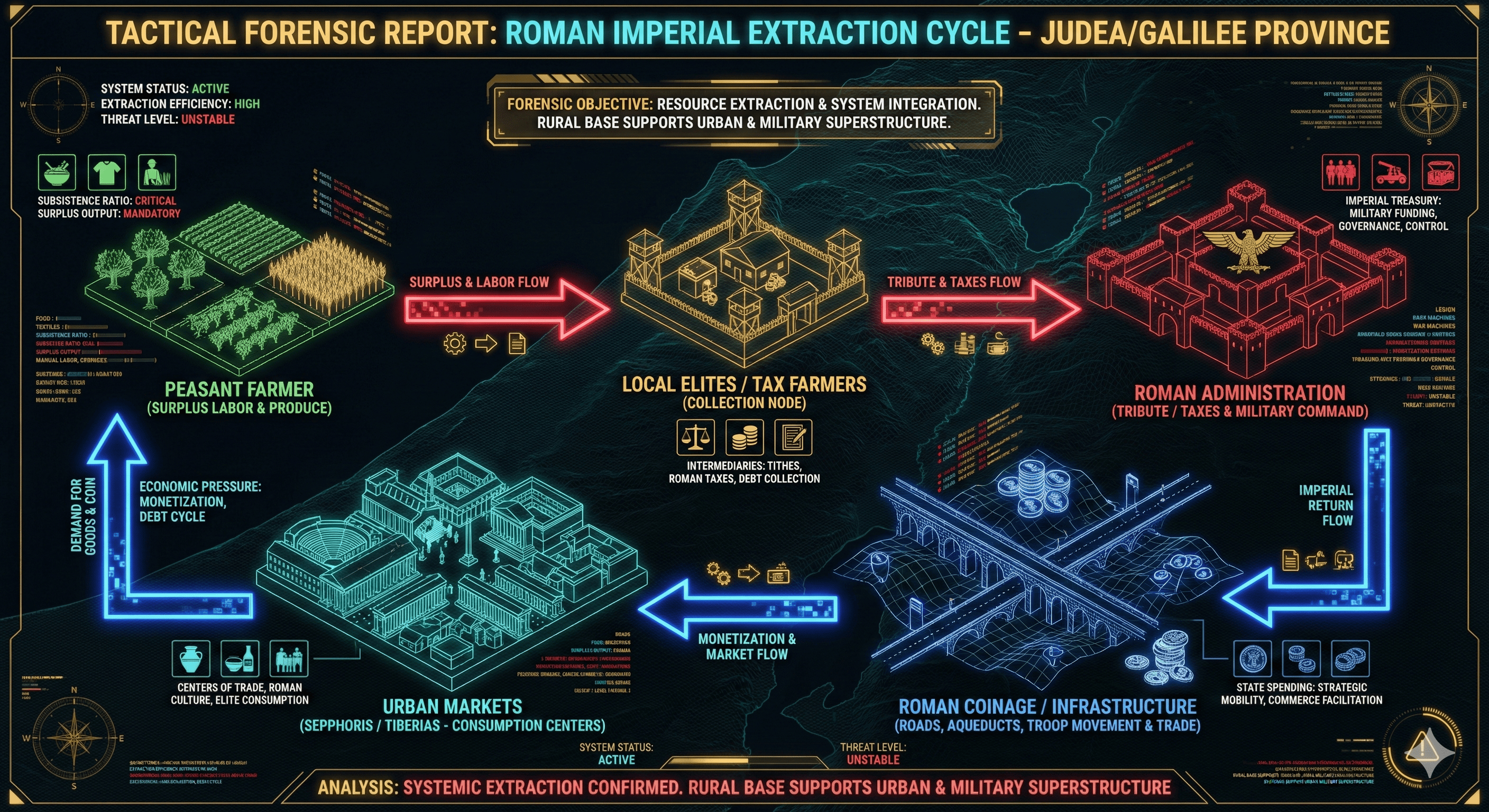
The integration of Galilee into the Roman imperial economy in the first century CE was not a passive process of "trade," but a violent restructuring of life itself. The region colloquially known as the "Evangelical Triangle"—comprising Capernaum, Chorazin, and Bethsaida—was a "Stress Fracture Zone," buckling under the tectonic pressure of being forcibly welded into the globalized Roman economy.
// 01. THE INDUSTRIAL NORTH: FISH & EXPORT
Far from being a quiet backwater of simple fishermen, the North Shore of the Sea of Galilee was an industrial engine room. The production of Garum (fish sauce) and salted fish at Magdala (Tarichaea) connected Galilean peasants directly to markets as distant as Rome.
SYSTEM ANALYSIS: THE COMMODITY TRAP
The shift from subsistence fishing to industrial export meant that local resources were extracted for foreign wealth. The fishermen Peter and Andrew were not just catching dinner; they were cogs in a tax-heavy export machine run by toll collectors like Matthew.
| Location | Economic Function | Strategic Relevance |
|---|---|---|
| Capernaum | Border Town / Customs Station | First stop on the Via Maris (Trade Route). High tax velocity. |
| Magdala | Industrial Processing | Salted fish export center. Major employer of day laborers. |
| Tiberias | Capital / Consumption Hub | Parasitic city built by Herod Antipas to consume rural surplus. |
// 02. THE TRIPLE TAX BURDEN
The Galilean peasant faced a "Triple Extraction" layer that made capital accumulation impossible. The demand for taxes in coin (rather than goods) forced farmers into the market at unfavorable times, leading to a cycle of debt and foreclosure.
"And they brought it. He said to them, 'Whose likeness and inscription is this?' They said to him, 'Caesar's.' Jesus said to them, 'Render to Caesar the things that are Caesar's, and to God the things that are God's.'"
Mark 12:16-17 (ESV)
| Currency Unit | Value Equivalent | Economic Context |
|---|---|---|
| Denarius (Silver) | 1 Day's Wage (Laborer) | Standard Roman tax coin. Required for Imperial Tribute. |
| Tyrian Shekel (Silver) | 4 Denarii | High purity. The only coin accepted for Temple Tax. Created money-changing market. |
| Lepton/Mite (Bronze) | 1/128th Denarius | Local Judean mint. The currency of the poor (Widow's Mite). |
// 03. THE DEBT CYCLE & DISPOSSESSION
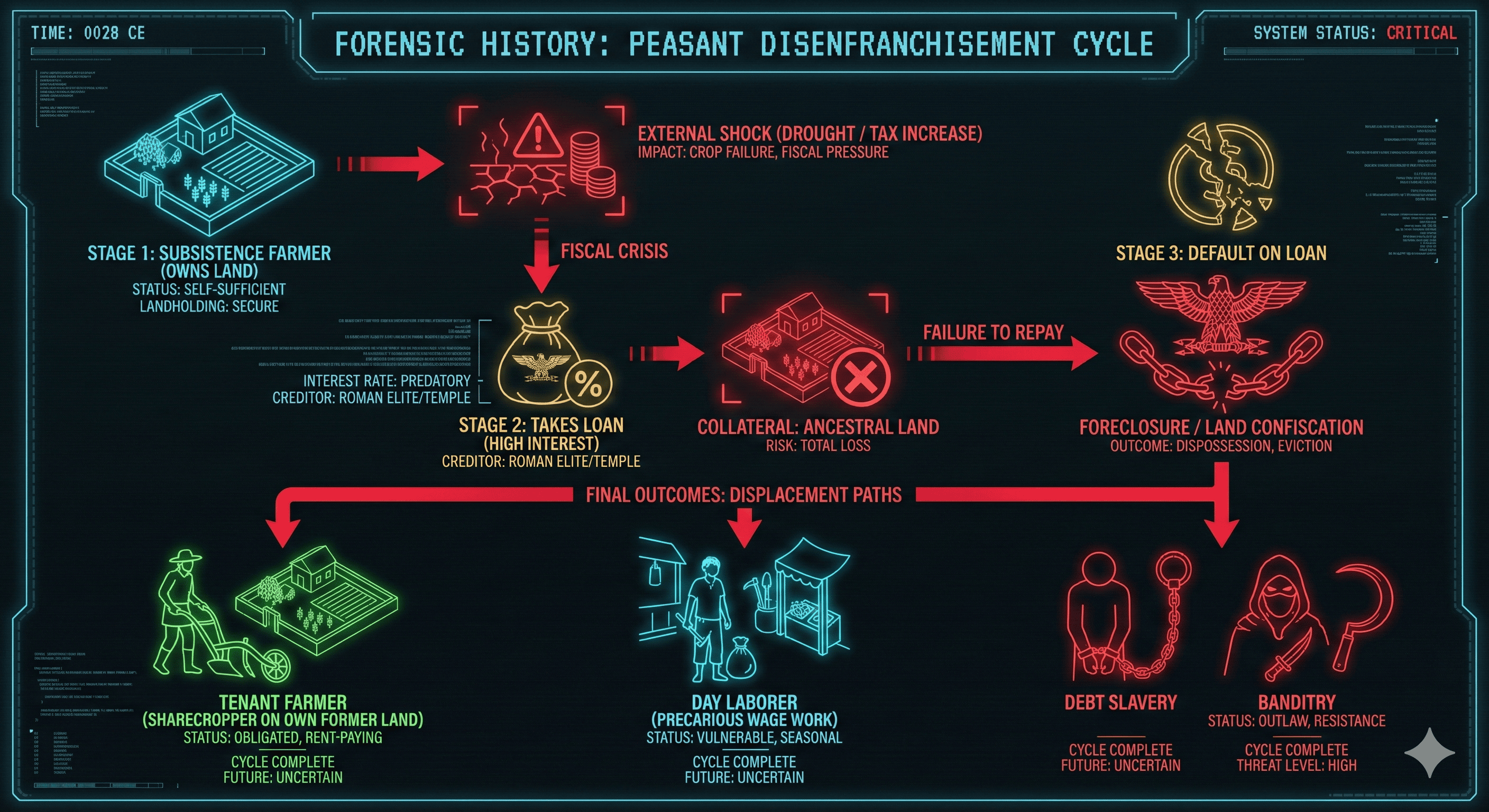
When a peasant couldn't pay the triple tax, they borrowed. Interest rates in the provinces could reach 48%. When they defaulted, they lost their ancestral land (nachalah) and became tenant farmers on their own soil. This created the volatile class of "Bandits" (Lestai)—often simply dispossessed farmers with nothing left to lose.
FORENSIC INSIGHT: THE LATIFUNDIA MODEL
The consolidation of small holdings into large estates (Latifundia) was the feature, not a bug, of Roman policy. It streamlined tax collection for the Empire but shattered the social fabric of the province.
// 04. CASE STUDY: THE RICH YOUNG RULER (MATTHEW 19:16–24)
In Matthew 19:16–24 (ESV), the encounter with the rich young man provides a case study of the economic "Stress Fracture Zone." While the text does not explicitly name his business, we can use the forensic markers of the First Century Galilean and Judean economy to determine his probable sources of wealth and religious alignment.
ECONOMIC PROFILE: THE MEANS OF WEALTH
Based on the "Triple Extraction" layers and the consolidation of land described in your research, this young man likely generated his wealth through two primary channels:
1. Land Ownership (The Latifundia Model)
In the first century, "great possessions" (Matthew 19:22) almost always referred to land.
2. Tax Farming or "Banking Interface"
The young man is described as a "ruler" (Luke 18:18). This suggests he held an administrative position that likely interfaced with the Roman economic machine.
1. Land Ownership (The Latifundia Model)
In the first century, "great possessions" (Matthew 19:22) almost always referred to land.
- The Debt Cycle: He likely benefited from the system where peasants, unable to pay taxes in coin, defaulted on loans.
- Dispossession: His wealth was probably built on the consolidation of small ancestral holdings (nachalah) into large estates worked by tenant farmers or "bandits" who had lost everything.
- The Commodity Trap: If his land was in the north, he likely shifted from subsistence farming to industrial exports like grain for the Annona or salted fish for global markets.
2. Tax Farming or "Banking Interface"
The young man is described as a "ruler" (Luke 18:18). This suggests he held an administrative position that likely interfaced with the Roman economic machine.
- Revenue Streams: He may have been involved in the high-velocity tax stations like those in Capernaum or the money-changing markets required for the Temple Tax.
// RELIGIOUS ALLIANCE: THE SADDUCEAN ARCHETYPE
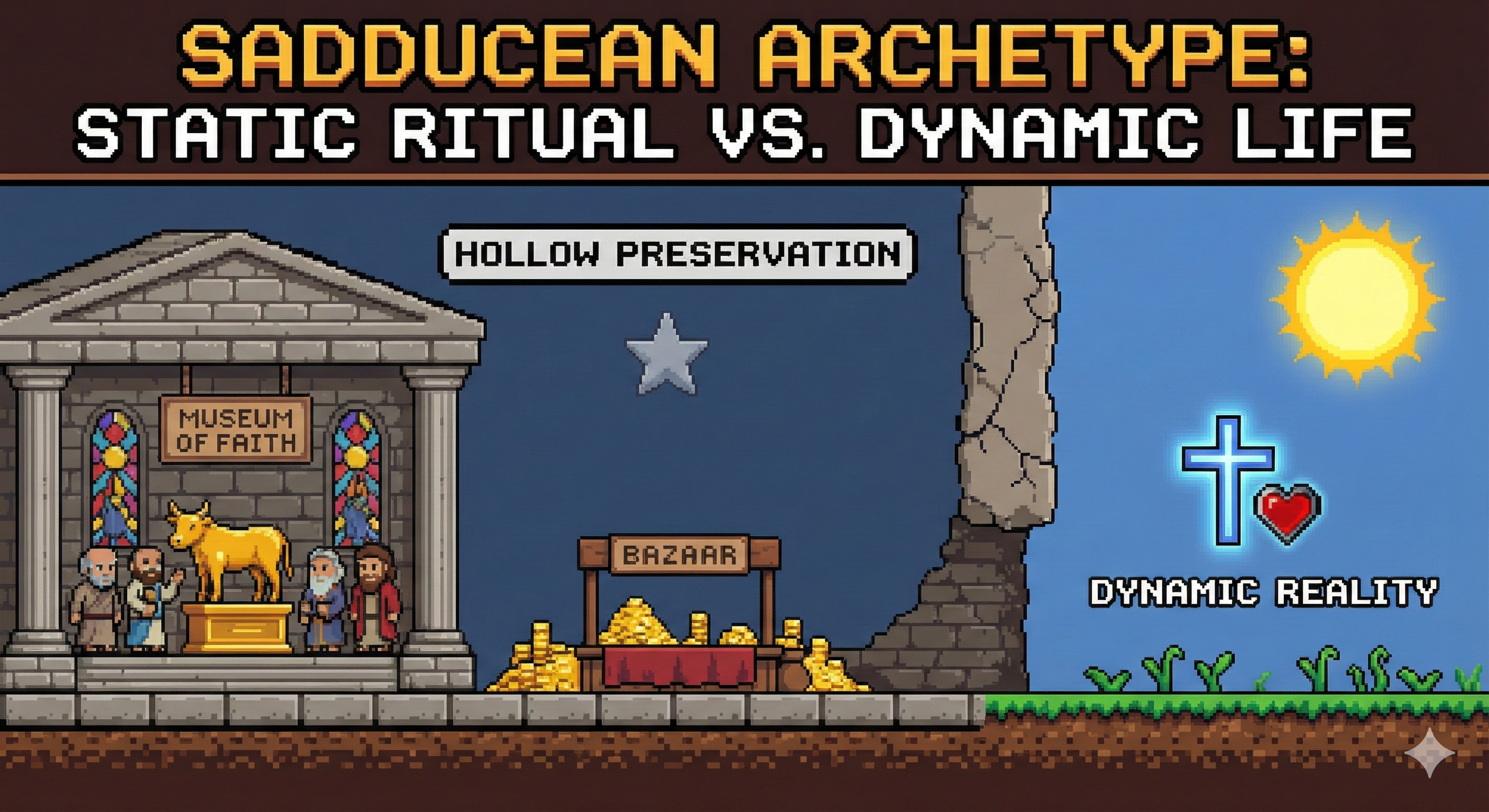
While the young man claims to keep the commandments (a trait often associated with Pharisees), his massive wealth and status as a "ruler" point strongly toward a Sadducean or Herodian alliance.
| Aspect | Pharisaic Lean | Sadducean Lean | Forensic Conclusion |
|---|---|---|---|
| Wealth Origin | Often middle-class tradesmen. | Aristocratic, land-owning elite. | Sadducee |
| Social Status | Popular leaders of the synagogues. | "Collaborators" with Roman infrastructure. | Sadducee |
| Theological Focus | Strict oral tradition / Resurrection. | Temple economy / Status quo. | Hybrid / Seeker |
WHY HE WAS LIKELY A SADDUCEAN "COLLABORATOR"
The Sadducees were the "custodial" aristocracy who managed the Temple economy for Rome. His reluctance to sell his possessions aligns with the Sadducean rejection of the "Jubilee of Heaven" in favor of the "Foreclosure of Rome". While he shows a Pharisaic interest in "eternal life," his economic reality was firmly embedded in the Sadducean banking interface that Jesus later assaulted in Jerusalem.
// ALIGNMENT WITH THE CONFLICT BLOCKS
He was structurally aligned with the blocks in conflict with Jesus, even if he was personally drawn to Him.
The Threat to Revenue: Jesus’ demand that he "sell what you possess" was a direct attack on the industrial extraction model that fueled the young man's lifestyle.
Economic Guerrilla Warfare: By walking away "sorrowful," the young man chose the predatory Roman "Iron Fist" over the parallel, anti-fragile society the Church was building.
The Verdict: He represents the "human souls" commodified by the "Beast" system (Revelation 18)—a man whose identity was so welded to Roman capital that he could not survive the "Divine Hijack".
The Threat to Revenue: Jesus’ demand that he "sell what you possess" was a direct attack on the industrial extraction model that fueled the young man's lifestyle.
Economic Guerrilla Warfare: By walking away "sorrowful," the young man chose the predatory Roman "Iron Fist" over the parallel, anti-fragile society the Church was building.
The Verdict: He represents the "human souls" commodified by the "Beast" system (Revelation 18)—a man whose identity was so welded to Roman capital that he could not survive the "Divine Hijack".
// 05. THE GLOBAL MACHINE: SICILY & EGYPT
The Galilean experience was not unique; it was a localized instance of a global Roman operating system. The Empire ran on the Annona—the massive grain supply required to feed the mob in Rome and the Legions on the frontier.
In Sicily and Egypt, the "Breadbasket Provinces," the extraction was total. Small farmers were crushed into the status of coloni (bound tenants) or sold into slavery to work the massive, senator-owned plantations.
In Sicily and Egypt, the "Breadbasket Provinces," the extraction was total. Small farmers were crushed into the status of coloni (bound tenants) or sold into slavery to work the massive, senator-owned plantations.
THE UNIVERSAL FREQUENCY
This shared suffering explains the explosive growth of the Gospel outside of Judea. When Paul spoke of a "Kingdom" where debts are cancelled and the lowly are exalted, it resonated with the Sicilian slave and the Egyptian tenant farmer just as deeply as it did with the Galilean fisherman. The economic pain was the universal carrier wave for the theological message.
// 06. THEOLOGICAL BLOWBACK
Jesus of Nazareth's parables were not abstract moral tales; they were economic commentaries targeting the specific pain points of this system. He spoke the language of debt, foreclosure, and unjust stewardship.
SCRIPTURE DATA: THE UNFORGIVING SERVANT
"Therefore the kingdom of heaven may be compared to a king who wished to settle accounts with his servants. When he began to settle, one was brought to him who owed him ten thousand talents. And since he could not pay, his master ordered him to be sold, with his wife and children and all that he had, and payment to be made. So the servant fell on his knees, imploring him, ‘Have patience with me, and I will pay you everything.’ And out of pity for him, the master of that servant released him and forgave him the debt.
But when that same servant went out, he found one of his fellow servants who owed him a hundred denarii, and seizing him, he began to choke him, saying, ‘Pay what you owe.’ So his fellow servant fell down and pleaded with him, ‘Have patience with me, and I will pay you.’ He refused and went and put him in prison until he should pay the debt." Matthew 18:23-30 (ESV)
But when that same servant went out, he found one of his fellow servants who owed him a hundred denarii, and seizing him, he began to choke him, saying, ‘Pay what you owe.’ So his fellow servant fell down and pleaded with him, ‘Have patience with me, and I will pay you.’ He refused and went and put him in prison until he should pay the debt." Matthew 18:23-30 (ESV)
LINGUISTIC INTEL: The Greek word used here for "debt" is opheilemata. In the Lord's Prayer ("Forgive us our debts"), this word is used, not the word for "sins" (hamartia) or "trespasses" (paraptomata). Jesus frames the relationship with God explicitly in economic terms to contrast the Jubilee of Heaven with the Foreclosure of Rome.
SCRIPTURE DATA: THE DISHONEST MANAGER
"He also said to the disciples, 'There was a rich man who had a manager, and charges were brought to him that this man was wasting his possessions... The manager said to himself, ‘What shall I do, since my master is taking the management away from me? I am not strong enough to dig, and I am ashamed to beg...’
So, summoning his master's debtors one by one, he said to the first, ‘How much do you owe my master?’ He said, ‘A hundred measures of oil.’ He said to him, ‘Take your bill, and sit down quickly and write fifty.’ Then he said to another, ‘And how much do you owe?’ He said, ‘A hundred measures of wheat.’ He said to him, ‘Take your bill, and write eighty.’" Luke 16:1-8 (ESV)
So, summoning his master's debtors one by one, he said to the first, ‘How much do you owe my master?’ He said, ‘A hundred measures of oil.’ He said to him, ‘Take your bill, and sit down quickly and write fifty.’ Then he said to another, ‘And how much do you owe?’ He said, ‘A hundred measures of wheat.’ He said to him, ‘Take your bill, and write eighty.’" Luke 16:1-8 (ESV)
FORENSIC NOTE: This parable is often misunderstood. The manager isn't stealing; he is likely removing the usurious interest added to the principal, which was illegal under Jewish law but standard Roman practice. By removing the interest, he wins the favor of the community and puts the Master in a position where he cannot complain without admitting to usury. It is an act of Economic Guerrilla Warfare.
// 07. THE DIVINE HIJACK: PAX ROMANA AS INFRASTRUCTURE
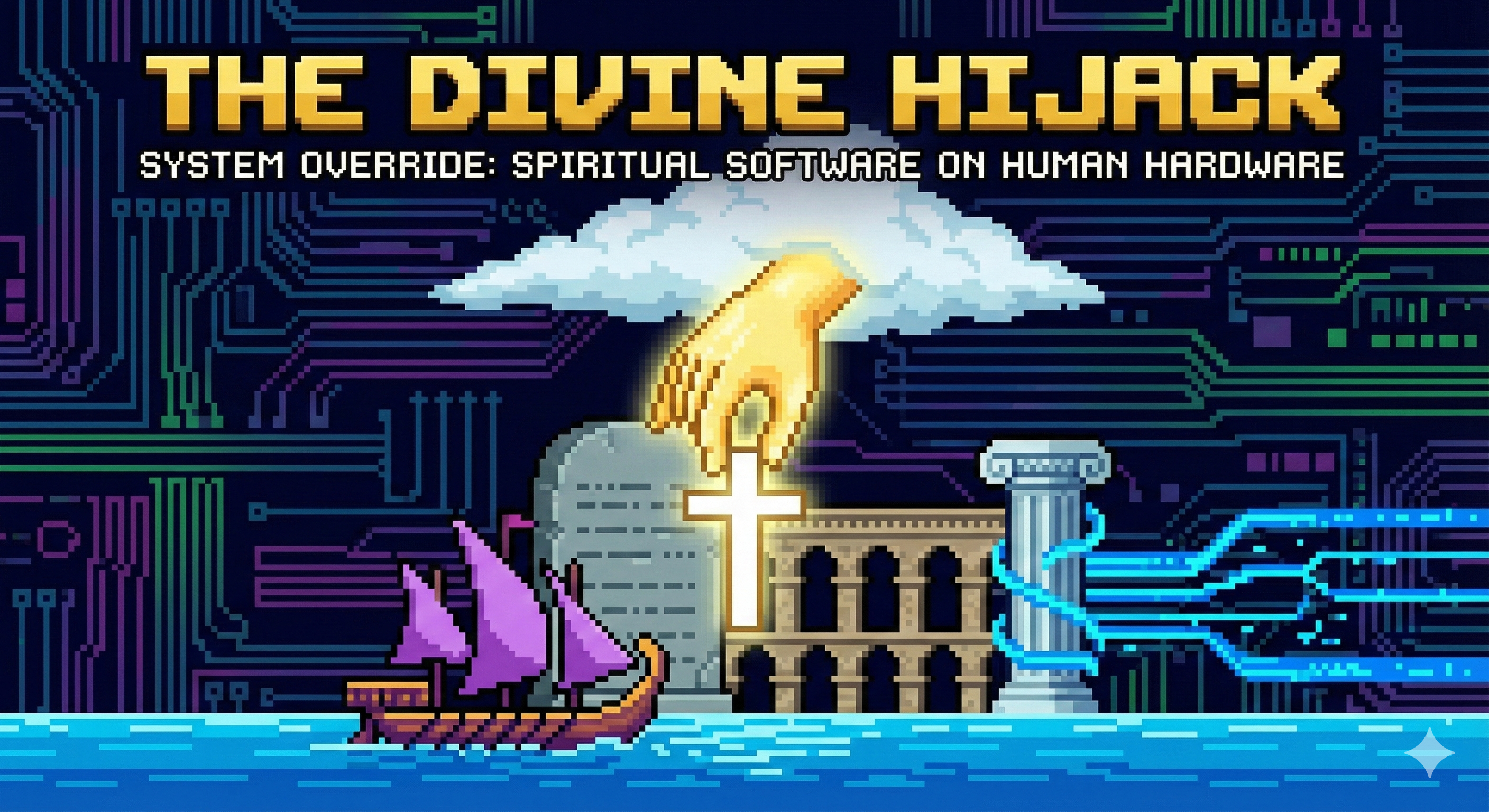
While the Roman economy was predatory, the "Pax Romana" provided the hardware for the Kingdom's expansion. God did not destroy the Roman system immediately; He hijacked it.
1. The Road Network: The Via Maris and Via Appia were built to move Legions and tax collectors. The Apostles used them to move the Gospel.
2. Koine Greek: Alexander the Great and Rome standardized language for trade and administration. This allowed the New Testament to be read from Spain to Syria without translation.
3. The Peace: The suppression of piracy and tribal warfare allowed relatively safe travel for missionaries like Paul.
1. The Road Network: The Via Maris and Via Appia were built to move Legions and tax collectors. The Apostles used them to move the Gospel.
2. Koine Greek: Alexander the Great and Rome standardized language for trade and administration. This allowed the New Testament to be read from Spain to Syria without translation.
3. The Peace: The suppression of piracy and tribal warfare allowed relatively safe travel for missionaries like Paul.
GRAND STRATEGY: THE LIFEBOAT PROTOCOL
Rome was committing economic suicide through debasement of the silver denarius (inflation) and crushing its productive class. The Church did not try to "fix" Rome; it built a parallel society (a lifeboat) within the sinking ship. By prohibiting usury and mandating charity, the Church created an antifragile economic zone that survived when the Western Empire collapsed in 476 AD.
// 08. THE JERUSALEM SHOWDOWN
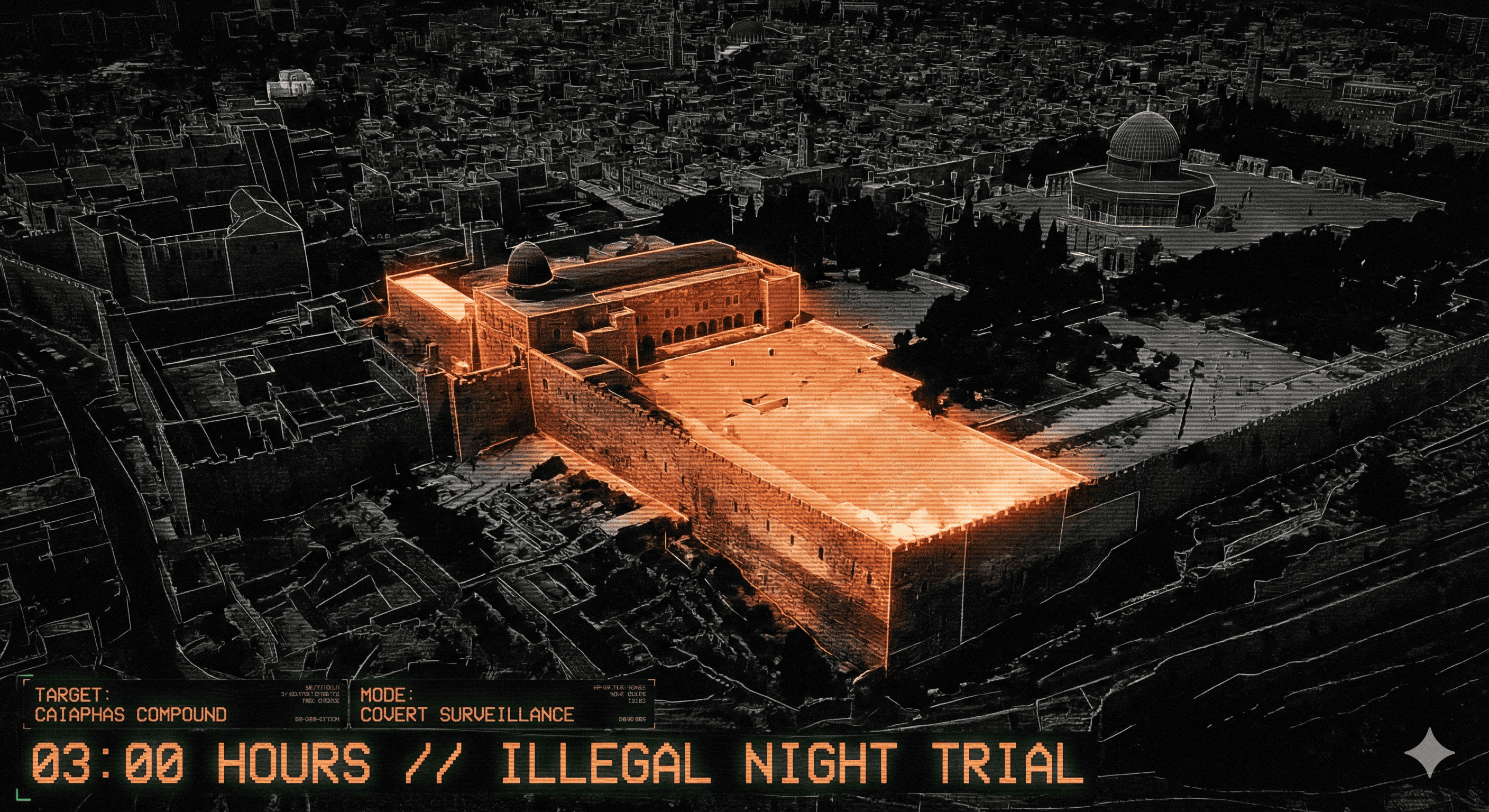
The culmination of Jesus' ministry was not just a theological debate; it was a direct assault on the economic engine of the Temple. The "Cleansing of the Temple" was the only time Jesus used physical force. He did not target the Roman garrison (Antonia Fortress); he targeted the banking interface where Roman currency was exchanged for Temple Shekels.
SCRIPTURE DATA: THE WHIP OF CORDS
"The Passover of the Jews was at hand, and Jesus went up to Jerusalem. In the temple he found those who were selling oxen and sheep and pigeons, and the money-changers sitting there. And making a whip of cords, he drove them all out of the temple, with the sheep and oxen. And he poured out the coins of the money-changers and overturned their tables. And he told those who sold the pigeons, 'Take these things away; do not make my Father's house a house of trade.'"
John 2:13-16 (ESV)
This was the flashpoint. By disrupting the cash flow of the Sadducean aristocracy, He forced their hand. They could tolerate a teacher; they could not tolerate a threat to their revenue stream.
SCRIPTURE DATA: THE VERDICT ON ROME (BABYLON)
"The merchants of the earth weep and mourn for her, since no one buys their cargo anymore... cargo of gold, silver, jewels, pearls, fine linen, purple cloth... cattle and sheep, horses and chariots, and slaves, that is, human souls."
Revelation 18:11-13 (ESV)
SYSTEM VERDICT: The final judgment on the "Beast" system includes an indictment of its economic commodification of human life ("human souls").
// RELATED INTELLIGENCE
> SYSTEM ARCHITECT

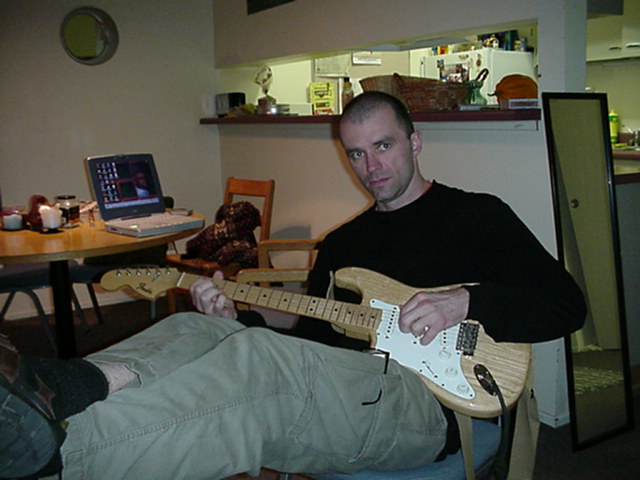


Lance Miller is the architect of lancemiller.org. His operational history includes a winter-over in Antarctica (Operation Deepfreeze '96, Congressional Medal), four years in the Alaskan fishing industry (Bering Sea, '99), and fighting the historic Biscuit Fire in the Siskiyou Mountains (2002). Holding a B.S. (2003), he later served as a Test Engineer on a technology team that won an Emmy Award (2008). Based in Seattle, he now merges Unix philosophy with theology to decode the Western Tradition.
[ X.COM PROFILE ]
[ X.COM PROFILE ]
[ TAP OPTIC TO CLOSE ]