System Architecture: The Pax Romana
Governance, Logistics, and the Fullness of Time
// SYSTEM DIRECTORY
// 00. OPERATIONAL CONTEXT: THE WORLD MACHINE
History is often viewed as a chaotic sequence of wars, but the Roman Empire represented something fundamentally different: the installation of a "World Operating System." Before Rome, the Mediterranean was a fractured landscape of tribal feuds and isolated city-states. Rome fused these into a single, cohesive interface known as the Pax Romana.
It was not merely a military conquest; it was a technological and cultural unification. While the hardware of the empire—the legions, the roads, the aqueducts—was distinctly Roman, the software running on it was Hellenistic. The language of commerce, literature, and philosophy was Koine Greek. This created a shared multicultural experience where a merchant from Syria could trade in Britain using a single currency and a single language.
It was not merely a military conquest; it was a technological and cultural unification. While the hardware of the empire—the legions, the roads, the aqueducts—was distinctly Roman, the software running on it was Hellenistic. The language of commerce, literature, and philosophy was Koine Greek. This created a shared multicultural experience where a merchant from Syria could trade in Britain using a single currency and a single language.
THEOLOGICAL INJECTION: THE FULLNESS OF TIME
It is no accident that the Son of God entered the timeline at this precise moment.
1. The Language Protocol: The Hebrew Scriptures had already been translated into the empire-wide standard, Koine Greek (the Septuagint). When the Apostles spoke, the world possessed the linguistic key to understand them.
2. The Network: The Roman roads meant the Gospel could travel safely from Jerusalem to Rome.
The "Macedonian Call" (Acts 16)
3. The Peace: The Pax Romana provided the stability necessary for a message of peace to take root.
Into this uniquely interconnected, literate, and unified system, the "Signal" of Christ was broadcast.
1. The Language Protocol: The Hebrew Scriptures had already been translated into the empire-wide standard, Koine Greek (the Septuagint). When the Apostles spoke, the world possessed the linguistic key to understand them.
2. The Network: The Roman roads meant the Gospel could travel safely from Jerusalem to Rome.
The "Macedonian Call" (Acts 16)
3. The Peace: The Pax Romana provided the stability necessary for a message of peace to take root.
Into this uniquely interconnected, literate, and unified system, the "Signal" of Christ was broadcast.
// 01. GOVERNANCE: IMPERIAL VS. SENATORIAL CONTROL
The genius of the Augustan settlement was a binary administrative system. Rome did not govern all provinces equally; it distinguished between safe zones and danger zones.
SYSTEM DIVISION:
- Senatorial Provinces (The Core): These were the pacified, wealthy regions (Africa, Asia, Achaea). Governed by proconsuls chosen by the Senate. No legions were stationed here. This was the civilian administration.
- Imperial Provinces (The Edge): These were the volatile frontiers (Germania, Syria). Governed by legates appointed directly by the Emperor. The legions were stationed here. The Emperor held the sword.
CASE STUDY: JUDEA
Judea highlights the system's flexibility. It was a volatile node requiring direct Imperial oversight via a Prefect (like Pontius Pilate). It was too unstable for the Senate; it required the direct hand of the Emperor's military apparatus.
// 02. DEMOGRAPHICS: THE EDGE AND THE CITIZEN
The Roman Empire was never a monolith. It was a mechanism for integration. The most dynamic innovation occurred not in the marble center, but on the gritty periphery—the Limes.
THE LIMES AS MELTING POT:
The fortified boundaries were not just walls; they were porous economic zones. Legions on the Danube or Hadrian's Wall were multi-ethnic communities where Egyptian soldiers might serve alongside Germanic auxiliaries. This was the "Constructive Selection" of the empire, where barbarian vigor met Roman discipline.
UNIVERSAL ACCESS:
The Edict of Caracalla (212 AD): This massive system update granted full Roman citizenship to nearly all free inhabitants. It obliterated the distinction between "conqueror" and "conquered," solidifying a universal Roman identity.
// 03. LOGISTICS: THE CINNAMON ROAD
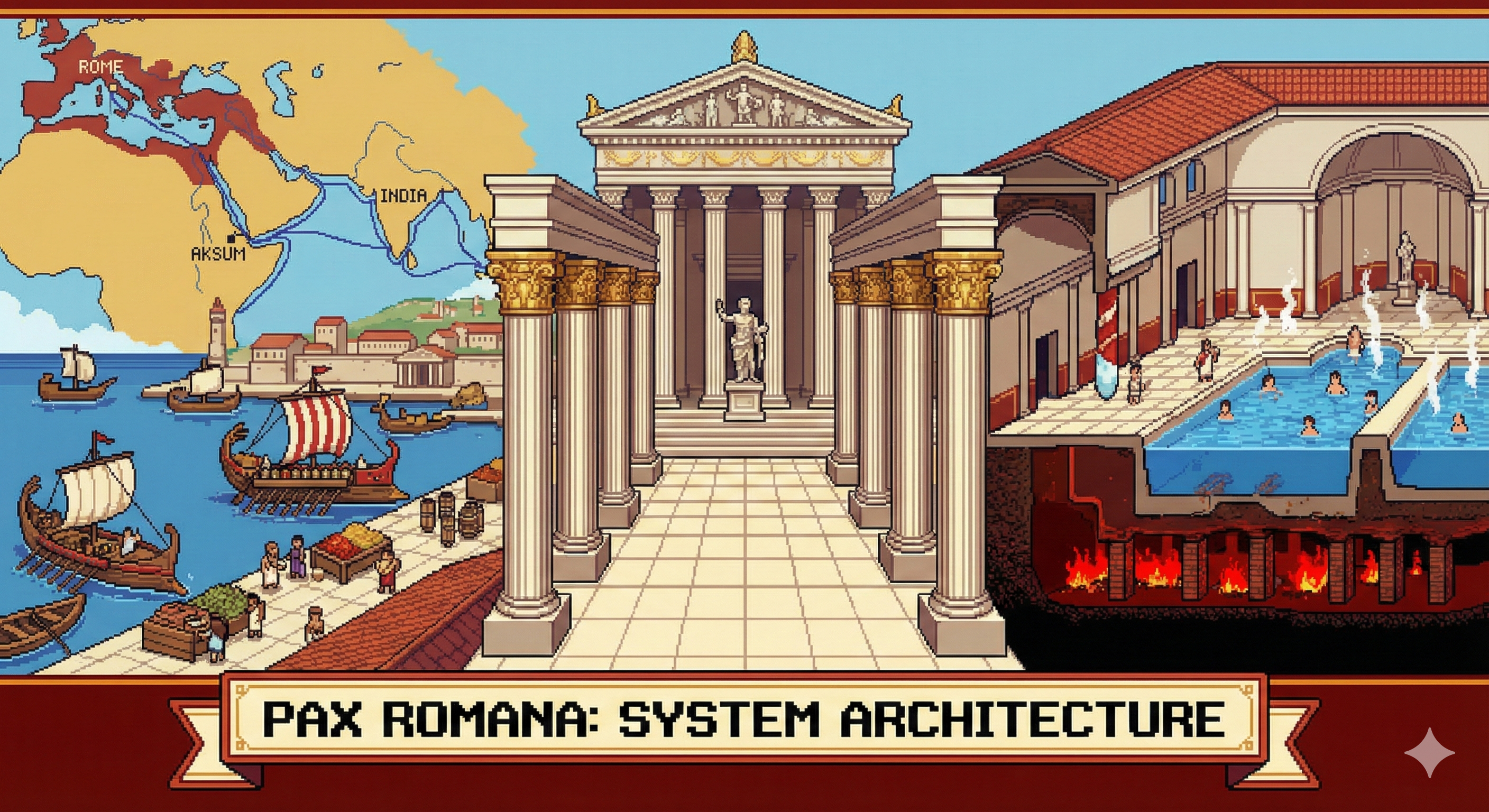
The Pax Romana created a vacuum of demand that sucked luxury goods from the ends of the earth. The "Cinnamon Road" was not a single path, but a complex maritime and overland network linking the Roman consumer to the distant markets of India and China.
STRATEGIC NODE: AKSUM & THE RED SEA
The Kingdom of Aksum (modern Ethiopia/Eritrea) rose as the critical middleware controller of this network.
- The Gatekeeper Ports: Roman trade flowed from Egyptian ports like Berenike down the Red Sea to the Aksumite port of Adulis. Here, African ivory, gold, and frankincense were loaded.
- The Monsoon Engine: From Adulis and the Yemeni coast, ships utilized the predictable Hippalus winds (monsoons) to rocket across the Arabian Sea to the ports of Muziris and Barygaza in India.
- The Return Loop: Indian pepper, Chinese silk, and cinnamon were brought back on the reverse monsoon, creating a high-velocity global trade loop.
- The Drain: Pliny the Elder lamented that 100 million sesterces annually flowed out of Rome to India, China, and Arabia. This proves the sheer scale of the global economy Rome engineered.
// 04. INFRASTRUCTURE: THE HYDRAULIC STATE
The most visible projection of Roman power was not the sword, but the bath. The Thermae were state-subsidized "Social Hubs" that provided high-volume hygiene as a civic right, distinguishing the Roman citizen from the "unwashed barbarian."
THE RITUAL SEQUENCE:
The Roman bath was a calibrated physiological process, moving the body through distinct temperature zones to purge and balance the humors:
APODYTERIUM
Entry / Changing Room
Entry / Changing Room
PALAESTRA
Exercise / Sweat
Exercise / Sweat
TEPIDARIUM
Warm Room (Acclimation)
Warm Room (Acclimation)
CALDARIUM
Hot Room (Humoral Purge)
Hot Room (Humoral Purge)
FRIGIDARIUM
Cold Room (Closing Pores)
Cold Room (Closing Pores)
ENGINEERING SPECS:
- Scale: Rome provided 200-500 liters of water per capita daily via gravity-fed aqueducts.
- The Hypocaust: A central heating system where furnaces (*Praefurnium*) circulated hot air under raised floors, powering the Caldarium (Hot Room) and Tepidarium.
- Medical Protocol: Based on Galenic theory, bathing was a medical regimen to balance the humors, not just a cleaning ritual.
THE GREAT RETREAT:
When the Roman "World Machine" collapsed, the specialized knowledge to maintain gravity-fed aqueducts vanished. Europe plunged into a "Hydraulic Retreat." Commoners went from effortless, subsidized thermal baths to hauling water buckets by hand. It would take nearly 1,500 years—until the mid-20th century—for the average European to regain the level of hygiene access enjoyed by a Roman plebeian.